How long are you going to live? Average life expectancy today for a typical American is about 80 years.
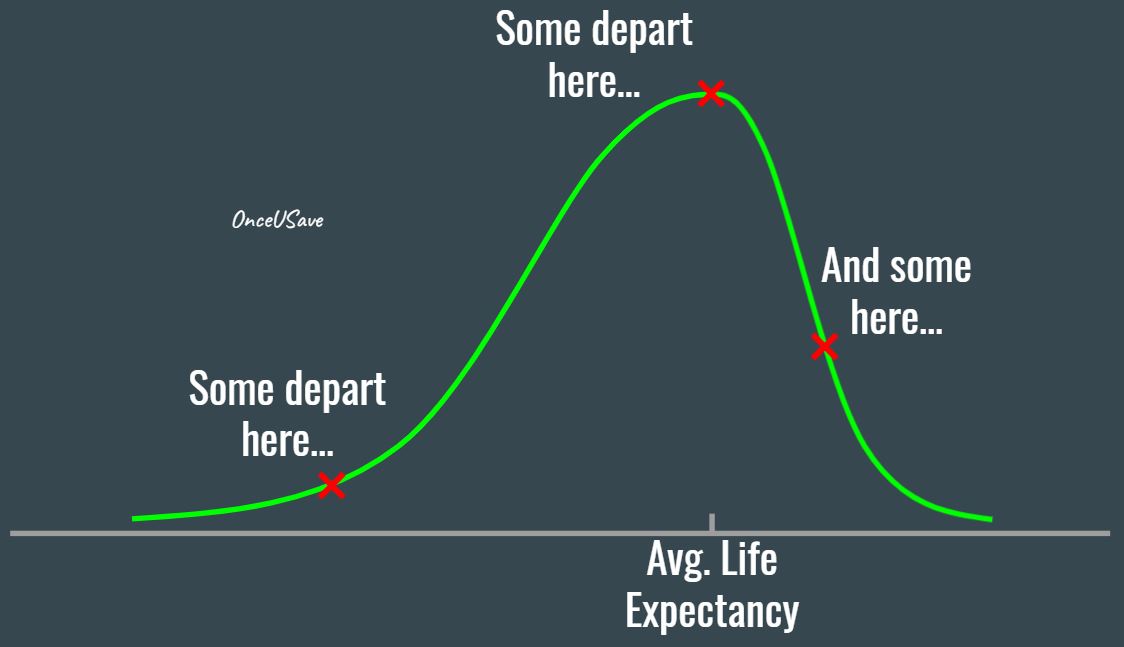
And it is somewhat distributed like this…
It is skewed left because some unlucky few will lie on the extreme left of the distribution, a major chunk will live close to the average and some to the right of that average. That is today and this distribution will shift right over time as life expectancies continue to rise.
So, if you are planning your own retirement, what life expectancy would you assume? Because that is the holy grail. You know that and the rest is easy.
But we do not know that and that is why retirement planning is so tricky.
That was not always the case though.
Most employers offered something called a defined benefit pension plan. A pension plan fundamentally is a risk-reduction setup, designed to guarantee that no one who participates in that plan goes without income during retirement.
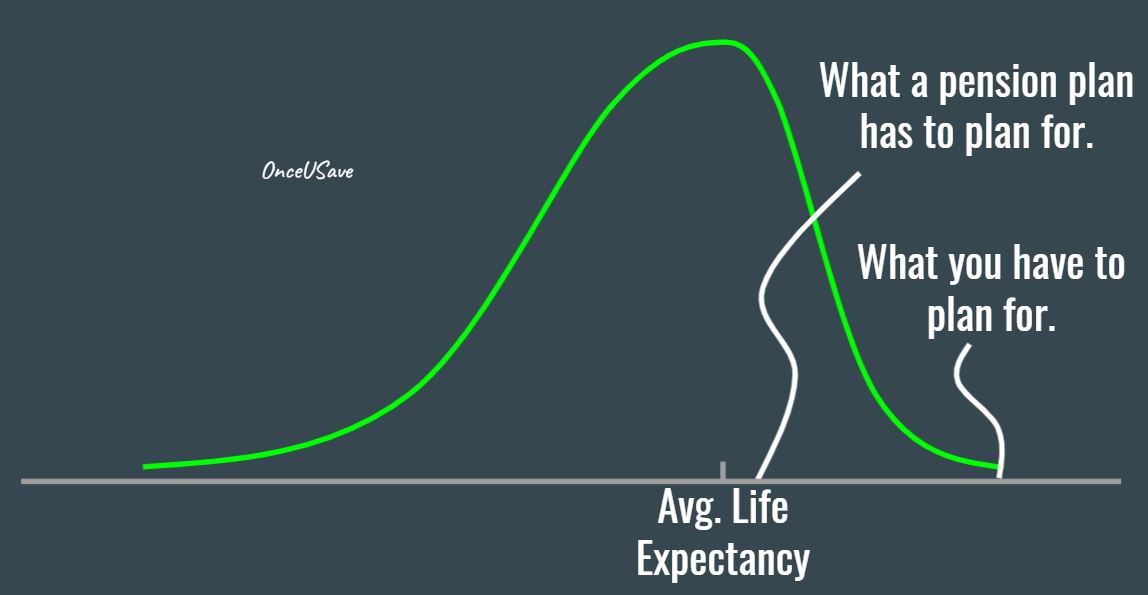
And because life expectancy risk gets pooled in a pension plan means that we did not have to save as much. Folks dying early paid for those who lived longer. All that was required of the plan to remain solvent was to have enough assets to cover life expectancies up to just to the right of the average life expectancy to accommodate for some buffer.
And not just that, the employers we worked for hired the best number crunchers money could buy to design a plan that lasts. You didn’t have to lift a finger. You needn’t need to know what the markets or the economy were doing at any given time. You just did your life’s work and the rest fell in place.
But pensions plans have gone the way of the do-do bird. The businesses who offered these plans do not want anything to do with them. Why would or should a company in the business of making widgets take on this added burden and mostly, a liability of financial planning for their employees?
And who sticks around long enough to avail themselves of a pension these days anyway?
So, for all these reasons, you now must design your own pension plan. Not only do you have to invest right during your accumulation years, but you also must take the money out rightly from the many accounts you’ll own through your life in your distribution years.
But how long do you need to make your money last? Unlike a traditional pension plan, you now need to account for the fact that you could be a demographic outlier. That is, you might live way beyond what life expectancy tables show.
So, you have to design your own pension plan and because there is no pooling of life expectancy risk, you have to save more, much, much more than what you would have had to if you had access to traditional pensions.
But all is not lost in this game because unlike traditional pensions, your one-participant plan does not need to generate income till you retire. Your portfolio, hence, can afford more risk than what a traditional pension plan can. That then helps reduce the amount you need to save each year by some factor.
Plus, if you do happen to save more than you will ever be able to spend, the leftover assets are there to bequeath as you please.
That is not the case with traditional pensions because you depart from this planet and your pension departs with you. There are no assets to bequeath.
So that is all good but then many of us still invest by the seat of our pants. Markets sell-off and we panic. Markets ride high and we get euphoric. Most do not invest with a pension like discipline and structure. For this and many other reasons, I wish we could somehow go back to the retirement savings system of the past.
Because if you read what I read on how ill-prepared we are as a country on the retirement savings front, you’d be depressed. Because it will be a burden and the ill-prepared are going to bear the brunt of it.
Annuities are insurance products. And insurance is an expense. It is never an investment.
What do you get for that expense? Risk reduction (definition of insurance) but above all, peace of mind.
You buy life insurance to protect your loved ones from financial ruin in case you unexpectedly pass away. There is an insurable need there because you do not want your grieving family to have one more thing to deal with after you are gone.
There always must be an insurable need before you go near any insurance product. Your kids do not need life insurance as no one is financially dependent on them.
Yet they are still sold; the dumbest thing you can do with your money. It is like buying car insurance for your 5-year-old daughter.
That brings us back to annuities. We can make them as complex as complex can get but annuities quite simply are income guarantee plans.
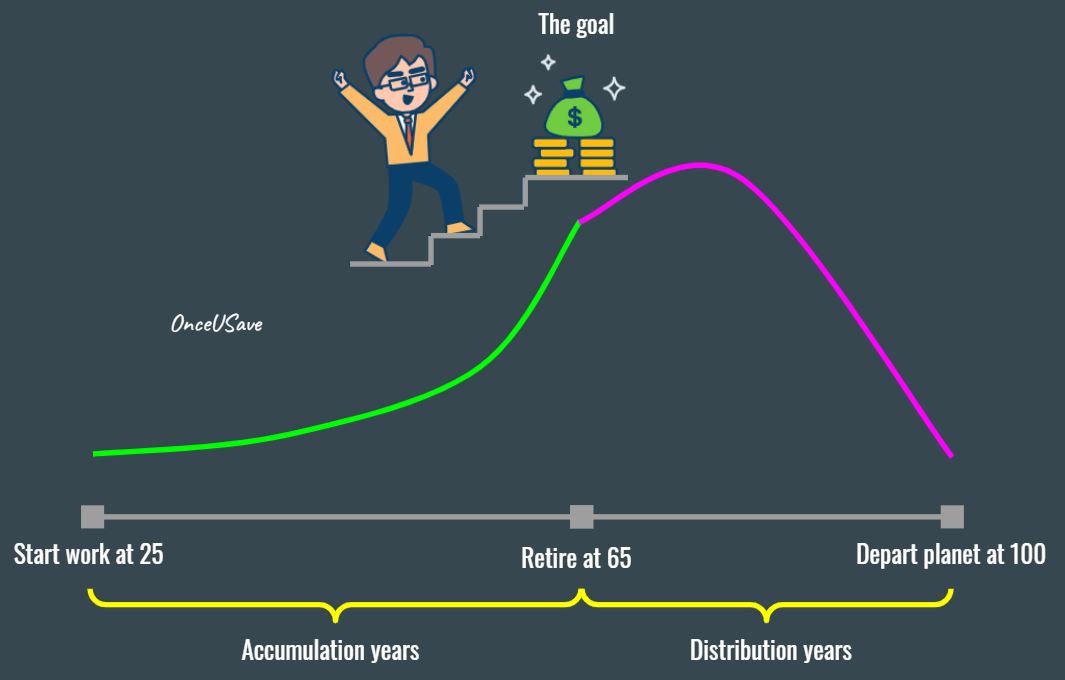
This below is a timeline of a typical saver…
There are accumulation years and distribution years. Accumulation years are when you set aside money in a portfolio of investments to help you reach your retirement goal. You then trickle out of those investments each year to live on until you depart this planet. Trickling out of your accumulated savings is the same thing as annuitizing or pensionizing your savings.
When you reach your goal, you have a decision to make. You can pensionize your savings on your own or you can give those savings to an insurance company and purchase say a Single-Premium Immediate Annuity (SPIA).
You’d then be guaranteeing yourself a certain fixed amount of income for life. No worrying about the markets or the economy. As long as the insurance company is around, you’d get your “paycheck”.
What does the insurance company do with your savings? They pool your cash with cash from say a million other customers and invest in a portfolio of investments that outearns what they have to pay out. They must outearn what they pay out because insurance businesses are not in the business of losing money. If the markets do not deliver as expected, the insurance company gets that money from you through increased costs for their products.
But if you die the day after you buy that annuity, life’s tough. That money is gone because you are indirectly paying for someone who happens to be in the same insurance pool and lives to be one hundred years old.
So quite naturally, you’d never want to do this with all your money. You would want to annuitize, if at all, say a tiny portion of your money that guarantees a bare subsistence level of income through the end of your life. The rest should be invested like you otherwise would.
But if the job of planning is done right through your accumulation years, there is seldom a need for this product – especially if you want to leave an inheritance behind.
And if it were me and if I had to choose, this is the only kind I’d buy.
That is mostly it for annuities, but we’ll continue along to learn more about the types you should maybe consider buying and the real insidious ones that you should never go near. Because the only kind that are sold are the insidious ones so it’s good to know about them.
There is a flavor of annuity I just described and that’s Single-Premium Deferred Annuity (SPDA), also called longevity annuity. You buy this at say age 65 but defer annuitizing it (collecting income) to say age 85. This costs you less because you don’t touch the money for twenty more years, but it serves the same purpose of protecting you against running out of money in case you live much longer than planned.
But if you die at say age 84, again, that money is gone. Not necessarily a problem as it served an insurable need.
I am still not a fan of these unless a better product comes along for reasons cited below:
You are taking a big inflation risk with them because these annuities make nominal payouts (not inflation-adjusted). You buy them for longevity insurance but guess what, 30 years of inflation will turn those dollars you’ll receive into funny money so that so-called income protection benefit fades away.
That risk is even bigger with a deferred annuity because you are not getting paid for many, many years. That payout might look good today but when it does come, you might be sorely disappointed with its purchasing power.
Also, you are taking a huge credit risk. These are all commercial products and though they have state guarantees, they (guarantees) are funded by the insurance industry. Most states have much lower caps on the amount that is protected and even those guarantees can fail when the insurance company fails. Just google the collapse of Executive Life Insurance.
Yet they are still all right if you truly need them, but these are not the ones ever sold. The ones you’ll be pitched are the ones that combine the accumulation and the distribution phases of a typical saver’s timeline into a single product.
And these are the ones you should stay away from. The first of its kind is an indexed annuity.
The stock market as we know is a volatile beast. It goes up and down like a yo-yo. We all love the ups but cannot deal with the downs.
So along comes this insurance salesperson, who pitches something so amazing that you cannot believe it could possibly exist. But it does.
You are going to get the up of the stock market but if the market goes down, you won’t lose money. That is the promise, and it is pushed hard every day because there is a lot of money to be made…from you.
Fancy vacations, tickets to high-profile sporting events etc. are some of the perks insurance companies shower on their agents selling these hugely profitable products. But these are the petty things.
The real money is made in commissions and the investment expenses they cleave out of your savings by the truckload at every chance they get.
Because this thing that is supposed to be an absolute grand slam for your wallet is actually a windfall for the broker and the insurance company selling it to you.
And that promise of you reaping the benefits of the stock market when it is up is never entirely true. Because what the insurers do in the contract you sign is that you get the upside of the market, but that upside is capped at a much lower number. That is disclosed deep down in their brochure in mice-type legalese that even a Harvard-trained lawyer cannot decipher.
I get these marketing materials clients send me when they are pitched these products, and they all look great on paper. But I know that is mostly fluff and the real truth only comes out once you buy them.
So yes, you get the upside but a much smaller upside.
And if you have been a stock market investor, you know that besides the gains in the value of your investments, dividends and reinvestment of dividends is where the real magic happens.
But with these products, you do not get the dividends. Who gets those dividends? You guessed it.
The second part of the promise is that you won’t lose money if the market declines. You won’t lose money only if you use the product exactly as written and stay in it for a decade.
If you need YOUR money before then, you lose the downside protection.
And then to add salt to that horrific wound, if you find out that you made a mistake and want out, you get hit with massive, gigantic, extreme penalties known as surrender charges. It is like Hotel California that you can check out of, but your money cannot leave.
The other main kind that is sold is a variable annuity and with these, the insurance company invests your money in a portfolio of investments just like you’d do in your 401(k).
Again, same sets of problems. Lots of fees and commissions up to a point where you would be better off investing your savings in Treasury bills.
So, the right kind of annuities are conditionally all right, but the wrong ones will rob you blind. Don’t do them.