Author: OnceUSave

  • You Don’t Want A Bull Market Early In Your Career

    You Don’t Want A Bull Market Early In Your Career

    There is no clear definition of a bull market except when the stock market seems to be uninterruptedly going up year in and year out and you sense a feeling of euphoria all around, that can be called a bull market. But that is a bad deal for you because what is the point of making 20% on a measly $50,000 investment balance you are likely to have at the beginning of your career.

    And that is not the least of the bad things because from now on, with all future contributions that you’ll make in your plan, you’ll be buying the same set of investments at a 20% mark-up. Who likes to pay more for anything and especially for a thing that you will keep buying over and over again for decades?

    But if that 20% bump in return came later after a lifetime of diligent investing, now that is a completely different ballgame. We are talking about real money here because a 20% bump on $5,000,000 is life changing whereas a 20% bump on $50,000 is barely worth it.

    You want the big gains to come later with itty-bitty gains during the early and middle phases of your career. I mean you want the markets to go nowhere while you are working and feeding your plan with fresh savings. And then right when you are about to retire, you want the biggest, baddest bull market in history to allow for all that accumulated dry powder to explode higher.

    That is the ideal and only a lucky few get to live it. Lucky not just from the perspective of timing but lucky from the perspective of persevering through it. Let me explain why.

    Say you happen to land your first job in January of 1966 when the Dow Jones Industrial Average stood at a mere 1,000 points. It would continue trading below that mark for the next seventeen years. Imagine watching the market go nowhere for seventeen long years?

    The Dow once again breached 1,000 points in December of 1982 before breaking out, never to look back. That would come to be the setting stage for one of the greatest bull markets in stock market history.

    So, if you entered the workforce in 1966 and started to stuff your investment accounts with fresh savings, you bought more and more of business profits at constant to down prices.

    And when the market turned, you were technically done. I mean your savings did all the work while you chilled.

    But with headlines like below towards the later stages of that extended bear market, how many folks do you think remained invested? And how many at that kept feeding their plans for the entirety of that period? Bet not many.
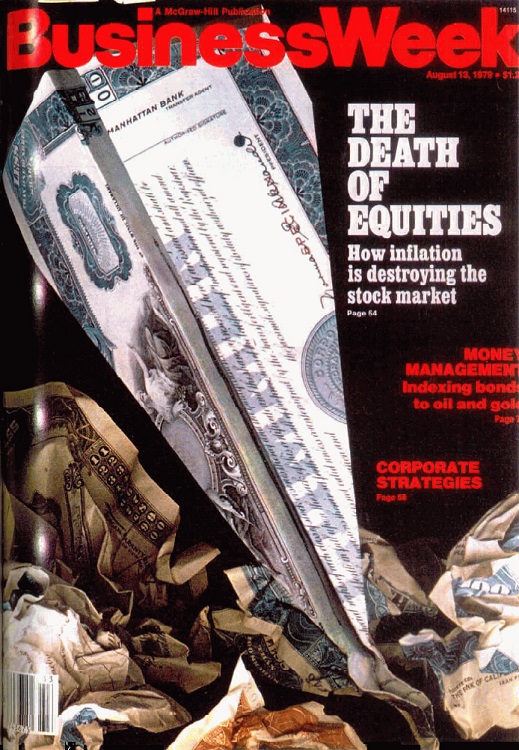
    Because to stick with your investments for that long of an underperformance with recurring crashes in the interim requires conviction. And conviction comes with knowing what you are investing in and why.

    But without conviction, you won’t be around to stick with your investments and follow through on your plan. Because you’ll bail at the worst possible time and then it is mostly over.

    And guess what was in vogue as an investment back then? Gold. Everyone wanted to invest in gold. When stocks treaded water, gold did like twenty times in ten years during the 1970s.
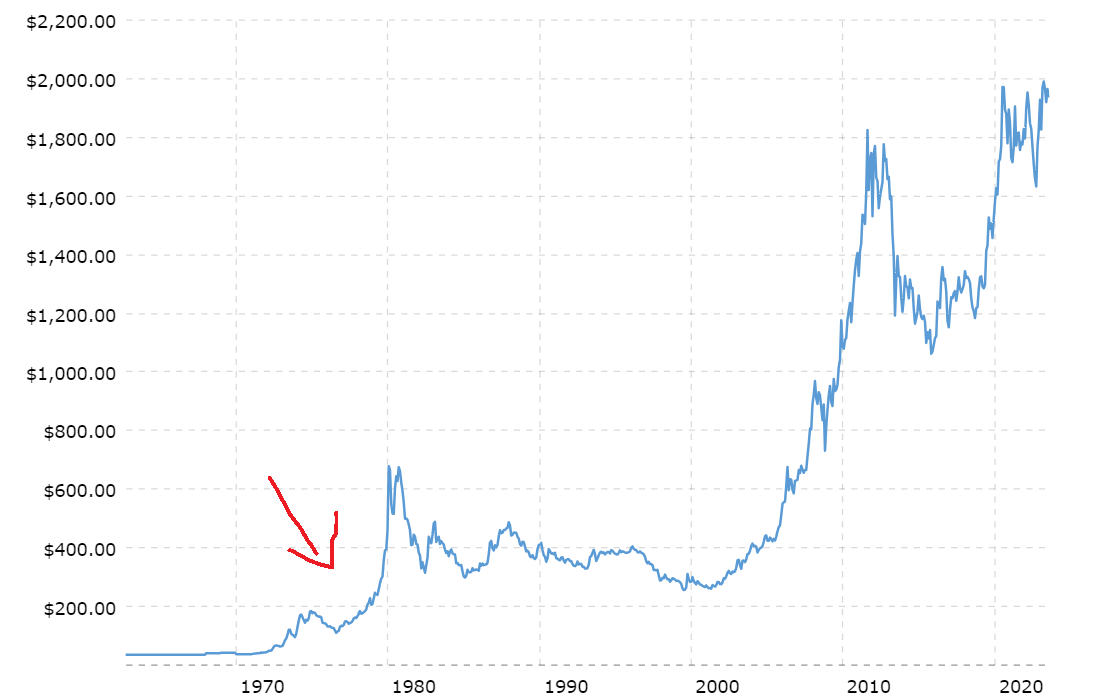
    Gold price history (not inflation-adjusted)
    Source: Macrotrends

    But gold is not an investment. It can never be an investment. No commodities are investments.

    And you’d think people got into gold before that big run-up? Not a chance. They got in right when that cycle was about to end. And that cycle likely ended forever.

    Why do I say that when the price of gold is a lot higher today than in the seventies? Because we have not factored in inflation yet.
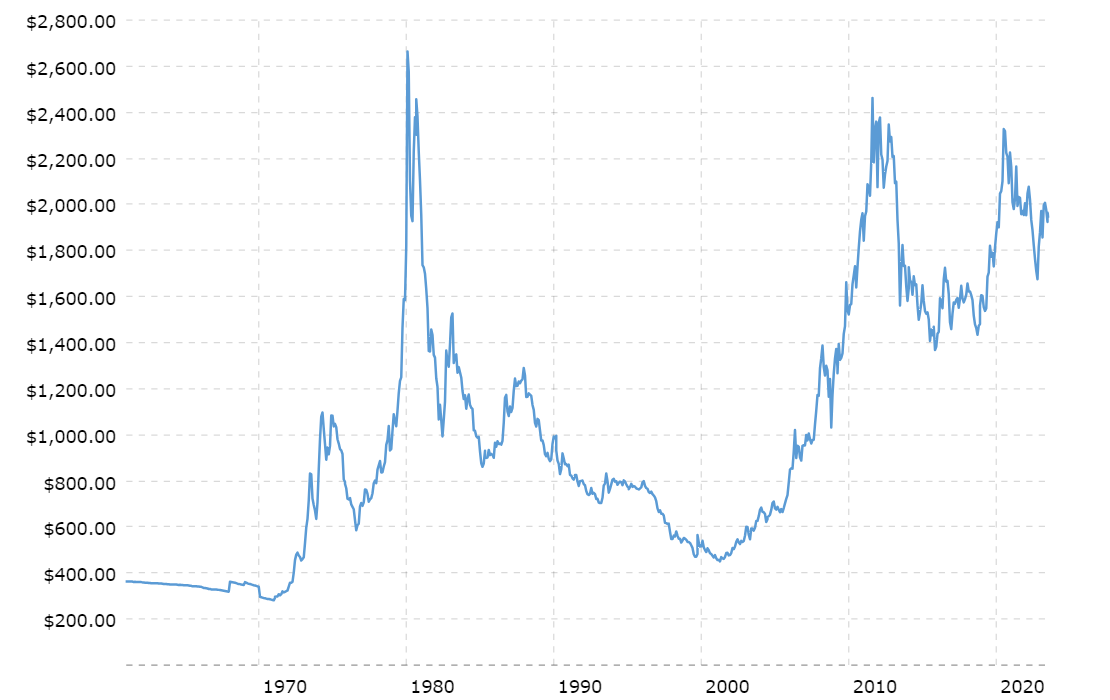
    Gold price history (inflation-adjusted)
    Source: Macrotrends

    So, if you bought gold thinking it is an investment, you’ll be sad today.

    But back to the topic at hand, what appeared to be the worst of times to invest when the stock market treaded water was in fact the best of times. And had you stayed invested and continued to plow new money into the markets, you got rich.

    How do I know? Because the next underwhelming phase in the stock market came during the decade of 2000s. The stock market as measured by the S&P 500 did not go anywhere for the entirety of that decade. That is not to discount that you also had to endure through two big market crashes in the interim – the Tech crash of the early 2000s and the subprime crash of 2008.

    But had you stayed invested and continued to plow new savings into the market, well, you know the story.

    Also, that underwhelming stock market performance only applied to the S&P 500 index that was dominated by the growth stocks of the era. Value stocks did fine. Small cap stocks did okay but international stocks is where all the action was.

    That story flipped again in the decade of 2010s. Growth stocks did great but value and international stocks underperformed. That cycle will turn again, we just don’t know when. Nobody does.

    Yet we must prepare for it. We must prepare for all possible scenarios because outcomes are never in our control, but the process is. And good planning requires getting the process right. Outcomes then fall in place on their own.

    Thank you for your time.

    Cover image credit – Becerra Govea, Pexels

  • If You Don’t Know How Much To Save, You Won’t Save Enough

    If You Don’t Know How Much To Save, You Won’t Save Enough

    Let us use saving for retirement as an example. The first thing you would want to know is the amount you would spend in the first year of your retirement. You’d then want to inflation-adjust that amount each year through retirement.

    You’d then want to know how long retirement will last. A 100-year life expectancy is what I would assume but you can adjust that number to what you think is right. Average life expectancy for anyone born in these United States is eighty years.

    You can use these pieces of information to know the target amount to save up to that will generate the income you need in retirement. This process of taking money out of your savings is called annuitizing your savings.

    But once you know the target amount to save up to, you’d then want to bring that amount to the present, assuming reasonable rates of return. You would then subtract from that what you have already saved, and that difference is the amount you’d want to save from now till you retire.

    So, say you are 50 years old and have $1.75 million saved spread across several accounts. And you want to retire in 10 years and draw $75,000 in inflation-adjusted income for 40 years in retirement. That is planning for a 100-year life expectancy that we just talked about.

    How much more would you need to save each year till you retire? Crunching the numbers gets us $32,000 to save each year.

    But say with everything remaining the same, you want more spending buffer that allows you to draw $100,000 in income from your savings. This will now require you to save $130,000 each year.

    For $25,000 more spending power, you need to now save FOUR times more each year. How? That is because you are drawing $25,000 more in inflation-adjusted money from your portfolio for 40 years in retirement, but you only have 10 years to save for it. And blame compound interest for that twisted math.

    But say that savings goal is tough to meet, and you can delay retirement by just two years to age 62. To guarantee the same $75,000 income stream for now 38 years in retirement, you only have to save $5,000 more each year. Much easier.

    And for a $100,000 annual income in retirement, you’d need to save $80,000 more each year. That is a far cry from the $130,000 required before. Two years of working more eases things quite a bit.

    Knowing how much to save for a big goal like retirement sorts other things out in life. Once you know that you are on track, you can then spend freely on things that matter in the present knowing that the future is taken care of.

    Thank you for your time.

    Cover image credit – Vlada Karpovich, Pexels

  • Umbrella Insurance

    Umbrella Insurance

    I am a worrier by design which means I try to protect what I need to protect through liberal use of insurance – life insurance for life, health insurance for health and auto insurance for my car.

    For my car? I don’t buy auto insurance to protect the value of my car because at some point in your life, the value of your car becomes an inconsequential fraction of all the other assets you own.

    In fact, I raise my deductible to the maximum allowed ($2,000 in my case) to pay out of pocket any damage to my car under that amount. That should reduce the collision and comprehensive coverage you pay by several hundred dollars each year.

    And once the fair market value of my vehicle drops to say below $10,000, I remove collision and comprehensive coverage entirely. You take your chances because you can afford to. That should save another several hundred dollars each year.

    What I do not scrimp on is liability coverage because that is what helps protect my assets. Because think about it – what is the biggest risk to your assets for someone who is regular rich? You look down on your phone for a split-second and you rear-end into another car, causing major injury to the other party or worse.

    So, I buy maximum liability coverage on my auto policy to protect my assets against these unforeseen events. Not that I should be looking down on my phone anyway.

    This below is the liability coverage I have on my auto policy that protects others but indirectly protects me…

    Bodily Injury $300,000/$500,000 : Pays $300,000 per individual or $500,000 per accident if I am responsible for causing someone injury or death in an accident. It also pays for my legal defense.

    Property Damage $100,000 : Pays in that amount if I am responsible for damage to another person’s property. That could be paying for any damage my car does to the other party’s car or home or anything that is deemed valuable.

    The liability coverage below pays out to me and my passengers…

    Uninsured & Underinsured Motorist $300,000/$500,000 : Pays for injuries caused to me and my fellow passengers by an uninsured, underinsured or hit-and-run motorist. It also pays for damage to my vehicle.

    Out of these three, the bodily injury damage is what I deem most important. Because in a major accident and assuming it is your fault, this would be your first line of defense.

    But we all know $500,000 per accident is not sufficient coverage in case you happen to hit a car full of lawyers. So how do I protect my assets beyond that?

    Through umbrella insurance. If you own say a million dollars in umbrella insurance and if the accident damage totals to a million dollars, the first $500,000 will be paid by your auto liability coverage and the remaining will be paid by the umbrella insurance policy you own.

    Umbrella insurance is designed to add extra liability coverage over and above say what your auto or homeowners’ insurance covers. It provides gap insurance when a claim exceeds the limits built into these policies.

    Insurance companies will require you to own maximum liability coverage before they let you add an umbrella policy on top and hence the $300,000/$500,000 bodily injury liability you see above on my auto policy.

    And because of that, umbrella policies are fairly cheap to own, like $500 a year for a million dollars in coverage. And it gets cheaper from there for each million you add.

    I would gauge the amount of assets you are trying to protect and buy the umbrella coverage accordingly. I’d say $2 million in coverage is plenty for 99% of the regular rich.

    Thank you for your time.

    Cover image credit – Matheus Bertelli, Pexels

  • Dividends Are Not Free Money

    Dividends Are Not Free Money

    Warren Buffett run Berkshire Hathaway paid a 10 cent dividend once in that one fateful year in 1967. Buffett, unarguably one of the best capital allocators ever, later joked that he must have been in the bathroom when that decision was made.

    Because of all the ways a business returns the harvested profits back to its owners, cash dividends is the least efficient. And here is why.

    When a business earns a profit, it has some decisions to make:

    • Reinvest all of it back into the business.
    • Reinvest some, return the rest in the form of dividends.
    • Return all of it in the form of dividends.

    The choice between the three will depend upon whether the business needs capital (money) to grow. And not just that, it needs to be able to deploy that precious capital at a respectable enough growth rate.

    Say that growth rate is 10 percent. So as a shareholder, would you then want that business to return some or all of the profit back to you?

    Probably not because now you will have to find another investment that will earn equal to or greater than that growth rate. There is hence that uncalled for reinvestment risk for you.

    And if you own the shares in a non-tax favored account, you will be taxed on those dividends. So not only do you face reinvestment risk, but you’ll also incur a tax drag every time dividends hit your account.

    But if reinvestment opportunities back into the business are limited, the management (the folks running the business on your behalf) will have no choice but to return some of the profit to you and to the rest of the owners. The business at this stage is in a moderate growth phase and is generating more profit than it knows what to do with.

    And only when all possible avenues for reinvestment are exhausted will the management decide to return the entirety of profits to the owners. There is no more growth left. The business at this stage is a bond-like investment. And the bond market is not where you go looking to get rich.

    All businesses go through these phases and when all is said and done, they either merge with other businesses or go extinct. That is capitalism.

    But all businesses eventually must pay out all their profits, past and present, to the owners in some form or the other. That is by design.

    But when we focus exclusively on the kinds that pay dividends, we miss out on a big chunk of the still growing businesses. Nothing wrong with that but the long-range returns are unlikely to outpace the returns of a portfolio that owns all kinds of businesses.

    And I’d especially be wary of businesses that pay unusually high dividend yields. Because there will be a catch. There will always be a catch.

    But even with dividends, there is a better way that the likes of Buffetts practice to return profits back to the owners. And that is through share buybacks and this is how it is done.

    We first start with the market value of a business…

    Market value of a business = Number of shares outstanding x Price per share

    So, say a business has 1,000 shares outstanding in the marketplace today and each share trades at $1,000. The market value of that business then is 1,000 shares x $1,000 = $1,000,000.

    Now say in a year, that business earns $100,000 in profits which the business for now retains on its books. So, with all things being equal, the value of that business should rise to $1,100,000. And the share price should now reflect the new value by rising to $1,100 per share.

    But say the business as it stands today has no reinvestment opportunities left. It has hence no need to retain the profits that it earned.

    The folks running the business on your behalf will then decide to issue the entire $100,000 profit in the form of a dividend. That would amount to $100 for each share you own.

    The share price post dividend distribution reverts to the original $1,000 apiece. And you are then left with the tax consequences of that dividend hitting your accounts whether you wanted it or not.

    What could have been better? Buying back shares in the open market from the current owners and retiring them in earnest.

    $100,000 buys ninety-one shares at the new share price of $1,100 and once the shares are purchased and retired from willing sellers, there are now 909 shares outstanding with each share trading at $1,100 apiece. The total value of the business post-share buyback reverts to $1,000,000 (909 shares x $1,100 share price).

    But even though the total value of the business did not change, your stake in that business grew by 10 percent. Or to put it another way, the value of your shares increased by 10 percent with no immediate tax consequences for you at that.

    You now get to decide when you want to take distributions by selling shares at your convenience instead of being forced to accept distributions on a preset basis in the form of cash dividends. And that is what you want. That is what most people in the know would want.

    So dividends are nice but they should not be your sole focus when designing a sustainable pension plan. Because when you focus too much on them, you’ll end up with a portfolio that will remain long-term inefficient.

    Thank you for your time.

    Cover image credit – Giuseppe Russo, Pexels

  • Survivorship Bias Is Everywhere

    Survivorship Bias Is Everywhere

    During World War II, researchers at the Center for Naval Analysis were trying to decide on where to add reinforcements to damaged aircrafts returning from their bombing missions. Reinforcements add extra weight so not all sections of the aircraft can be reinforced.

    Source: Wikipedia

    So, if you were given the task to decide, where would you add reinforcements? You’d add them to the damaged red parts of the aircraft, right?

    Abraham Wald, a mathematician, and a member of the Statistical Research Group at Columbia University proposed otherwise. Because what you were looking at were biased samples of only the aircrafts that survived the battle. An aircraft got hit evenly across all sections of its body but the ones that got hit in their most vulnerable parts did not return.

    The sections of the aircraft that suffered damage and were still able to return meant that they were not the weak spots you wanted to reinforce. You want to reinforce the areas that were still intact because if those areas got hit, the aircrafts did not return. The Navy followed through on Wald‘s advice which ended up saving countless lives.

    This is a classic case study on how not to fall prey to survivorship bias. Because our brains are wired to take shortcuts and reach false conclusions by looking at only the samples that survived. We don’t notice the bulk of the failures – in business, in life and in war.

    There are millions who play basketball but there are only a few Michael Jordans. There are millions who try their hand at acting but there are only a few Shah Rukh Khans. There are millions who drop out of school but there are only a few Mark Zuckerbergs.

    Our perception of the world is completely backwards because everything we see around us is the outcome of survivorship bias. When we go to a restaurant we like, that is an example of survivorship bias. Running a restaurant is a tough, tough business and the only ones we see left standing are the ones that survived while the remaining 99 percent failed trying.

    That in fact is true with businesses in general. Most businesses that start never make it past the first few years. But entrepreneurs keep trying because of the disproportionately large rewards at the other end if a business succeeds. That is a good thing, and we want more entrepreneurs to wildly succeed else no one would try.

    There is a huge survivorship bias in stock investing. We see the people who did well and what sticks in our minds are the folks who bought Amazon or Microsoft at their IPOs and held their shares. But what we don’t see are the other 99 percent of the IPO investors who had their heads handed to them.

    There was this story doing the rounds that goes something like this…Uncle Fred buys EMC stock twenty-five years ago and dies. His heirs discover the stock certificates in the attic, and they are worth like six million dollars. It makes the headlines, and everyone is talking about it.

    What nobody talks about are the other 99 percent of Uncle Freds who bought GM or Lehman Brothers or JCPenney, and when their heirs discover the stock certificates that are now worthless, nobody tells the newspapers, and no one hears about it.

    Mutual fund companies play these games well. They incubate like thirty funds and quietly wind down most of the unsuccessful ones while keeping the star performer alive. They use that fund’s performance record as a marketing gimmick to attract new money. And novice investors pile in as in anyone who invested in Cathie Wood‘s ARK set of funds lately.

    The stock market is the largest creator of wealth for individual investors, but most stocks lose money through their entirety of existence. That is the nature of capitalism working its magic where a tiny minority of businesses are responsible for the bulk of the wealth that has been created in the stock market.

    So, when you hear about how much this or that stock gained and how rich you would be had you bought and more importantly, held that stock, what you don’t hear about are all the losers that you also bought that you lost your shirt in.

    For every Walmart, there was once a Kmart. For every Apple, there was once a BlackBerry. For every Facebook, there was once a MySpace.

    Diversification is the only free lunch in investing so piling into a single stock or a sector is a statistically bad deal. That holds truer if you have already won the game. Diversification is an acceptance that the future is inherently unknowable, and that it can take many different directions. 

    Diversification also means not falling prey to survivorship bias because it is the failures that teach us the most important lessons – in life and in investing.

    Thank you for your time.

    Cover image credit – Ruyan Ayten, Pexels

  • Kids & Money

    Kids & Money

    There is seldom a parent who hasn’t gone through the tantrum-throwing phase of their kids’ lives. You walk into a store; your kid sees a toy and she must have it. The moment you say no and the next thing you see her rolling on the floor.

    I went through that phase as well.

    When my daughter was about four, I learned this neat trick from a book called The First National Bank of Dad by David Owen. It helped put an end to all her tantrums. The essence of it was allowing kids to control their own spending.

    And it starts with giving them an allowance. Sizing the allowance is subjective but at age four, I’d give $4 a week and raise it by a dollar on each birthday. So, if she wanted to buy a toy that cost $20, she’d have to wait five weeks to save up the cash to afford that toy. There are two benefits:

    • It teaches kids about delaying gratification. A seminal study and several follow on studies highlight the importance of being able to delay gratification as a key ingredient for success in many areas of life.
    • And almost always, in a few weeks, she would change her mind about getting that toy or completely forget about it.

    And a heartless dad that I was, I would hand out the allowance in small denominations and then have her store that in a transparent jar. So, on occasions that she would follow through on a purchase, she’ll feel the weight of emptying a sizable chunk of that piggy bank for what we all know would amount to literal junk that you’ll soon be trashing away anyway.

    I would also have another jar that would serve as the dad’s bank where if she moved her savings to, I’d double the transferred amount on one condition: any cash that would move to this savings jar must remain invested for 6 months minimum.

    Every Saturday would be a pocket money day where she would receive new allowance. That would also be a day where she would tally up all her savings. And then display her hoard on a whiteboard as well as track the amount in a spreadsheet for some pretty plotting as she watched compound interest take hold.

    Granted, this is more work for busy parents, but it is a great bonding exercise with all the pluses and literally no minuses.

    Grocery shopping is a great avenue to teach kids on how to make smart, responsible consumer decisions. Minimizing waste, making trade-offs and not being beholden to brands is a great way to teach them on how to stretch a dollar.

    And as they get older (teens), you discuss household finances and credit cards and interest rates and the benefits of using debt responsibly. You start to involve them in bigger purchase decisions like car buying, paying for college etc. You talk to them about compound interest, the stock market, opportunity costs and the rest. Use every chance you get to talk to them about all these things before you send them out to face the mean bad world.

    And kids do what you do. They don’t do what you say they should do. If your own house is in disarray, no amount of lecturing will fix their relationship with money. You might inadvertently be making things worse as they get conflicted messaging.

    My daughters are now old enough to tell me that they know everything, but I know much of that experimentation worked. I see them make decisions and they are qualifiedly fine. They have learned to be empathetic. They are good students. They work hard. They don’t get easily influenced. But regardless, it is still experimentation because each kid is different. Even the two sisters, growing up in the same household, are different.

    Money is not everything, but you get behaving with money right and life gets easy.

    Thank you for your time.

    Cover image credit – Cottonbro, Pexels

  • One Banker, Thousand Borrowers

    One Banker, Thousand Borrowers

    What you feel is a good investment because of what you see and hear is seldom a good investment. A good investment is usually the one you don’t hear much about. Or if you do, you only hear disgust and shame.

    Because when an investment feels disgusting to own, its perceived risk is higher and because of that, the availability of capital (money) flowing into that investment gets scarcer. It becomes an undercapitalized situation. No one wants to buy into its stock or bond.

    To attract capital, that investment needs to offer a better rate of return. Expected return hence for that investment is higher because the risk is higher. That is another way of saying that future cash flows for that investment are discounted at a rate higher than that for a perceivably less risky investment.

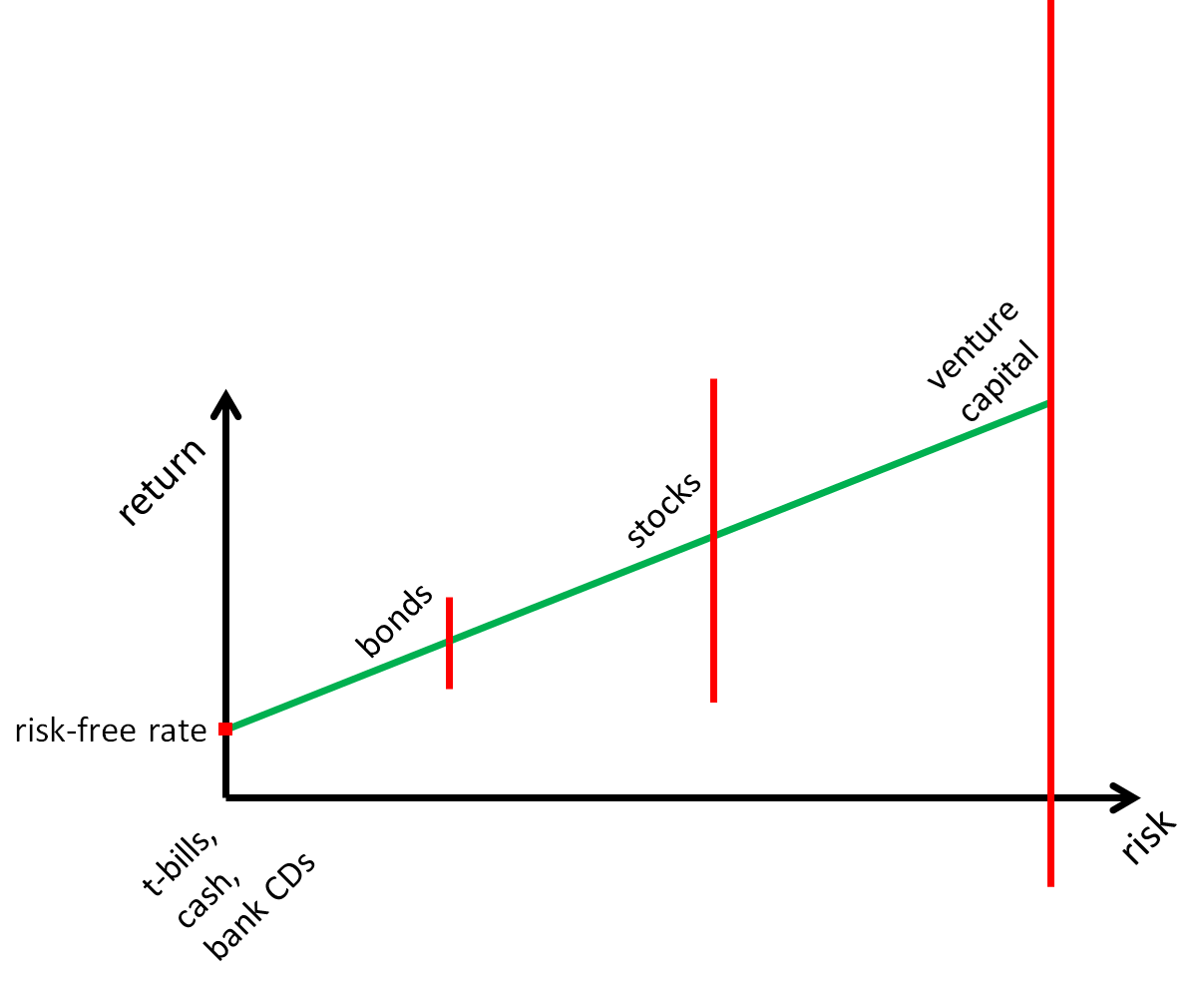
    Risk is about the range of expected future outcomes (returns). Bank CDs are the safest. Bonds are riskier. Stock investments are the riskiest. The venture capital bar is added for completeness sake but is not considered investable unless you are running a pension fund or an endowment.

    Bull markets in stocks see returns on the higher side of the average (green line), bear markets on the lower. And when a hot new theme like artificial intelligence comes about, stock prices in that corner of the market tend to go nutty. Everyone wants to buy into that theme because it is perceived as a guaranteed money-maker. Investor capital follows by the truckload, and it quickly becomes an overcapitalized situation.

    Richard Bernstein of Richard Bernstein Advisors describes this as being in a town with a thousand banks and one borrower. And when you are the only borrower and you have all these banks competing for your business, you are going to set the interest rate. And you are going to make out like a bandit because you are going to set those rates to be as low as possible.

    Turn it around and now say you are the only banker in a town with a thousand borrowers. You are going to mint it because you get to set the interest rate on each and every loan. And you are going to set them as high as possible.

    So, when it comes to the hot themes of the day, it is hard to argue that they are starved for capital. There are a thousand banks flooding the market with capital.

    And it is simple supply and demand of capital that sets the long-term return on investment. So, if you want to score big or if you don’t want to be left holding the bag, you want to look for situations no one wants to invest in.

    The question you should be asking hence is that everyone knows about artificial intelligence. It is going to change the economy. And quite a lot of that and more is likely already priced in.

    So where is that opportunity where you get to be that one banker against a thousand borrowers? That is likely staring in your face in some corner of your plan and that is where you’d want to invest.

    Thank you for your time.

    Cover image credit – Jplenio, Pexels

  • Bridging The Gaps

    Bridging The Gaps

    President Dwight D. Eisenhower was once quoted as saying that in preparing for a battle, I have found that plans are useless, but planning is indispensable.

    There is no perfect plan because change is the only constant. But that does not mean we do not plan.

    I like simplicity which means that that 50-page binder you get from that neighborhood finance guy is out the door. Your plan should be so simple and yet comprehensive enough that a 5-minute glance at it and you know what is going on with your money.

    That is the design I build into the plans you receive and a big part of the inspiration behind it comes from a book by Carl Richards called The One-Page Financial Plan. The essence of the book is to distill the complex into simple to help keep clients vested into their plans while stressing on the need for ongoing planning.

    And ongoing planning is important because life circumstances change, family dynamics change, markets evolve, your savings rate ebbs and flows – all these impact your plan.

    But an ever-evolving plan does not mean it has to change every day. There are tools out there that provide real-time updates on your money but that is way overkill. In fact, they can be downright detrimental as they suck you into watching micro-second level updates about your money on what is supposed to be a decades-long game.

    So apart from implementing tweaks here and there to keep the plan within its pre-defined guardrails, any more effort and we make things worse.

    But there might still be gaps that develop and that is what I want to address here. Take a goal like saving for retirement for example. There are two kinds of gaps we track there.

    The first is the required annual savings rate that is fundamental to your plan. That is derived from the amount of savings you have today and the amount that it needs to grow to to support your expenses in retirement. There is some behind the scenes net present value math and cash flow projecting that needs doing but nothing complicated.

        Running out of money before running out of time is the biggest fear retirement savers have so the required savings rate I like to design into your plans has a built-in conservatism to account for longevity and sequence of returns risk.

        But you meet the required savings goal outlined and everything and I mean everything falls into place.

        Your plans typically track a couple different retirement income scenarios to afford some optionality which then means you’ll see savings rate curves like these…

        This is the most important part of your plan. It tells you how the required savings rates have trended historically and what their state is today. You want to see these curves stay flat or trend down and there are only two ways to make that happen –

        • If the markets and consequentially your portfolio do better than the expectations built into your plans. That is possible but that is not something we get to control much beyond building a good portfolio for your station in life. Market forces decide the rest.
        • What is very much in your control is how much you save. So, if you see these curves perk up, you know what to do.

        And during the early part of your journey to financial independence, it is the savings rate that makes all the difference. So be deliberately maniacal about it.

        The second kind of gap we track is more structural and that relates to how your portfolio is divvied up between different categories of investments. A good portfolio means that there will always be some corner of it that is temporarily underperforming so that will create a gap from the desired portfolio targets.

        We fill that gap with new money that feeds your plan. But there are situations where contributions to your retirement plan at work is all you can do so we go looking to fill that gap in your 401(k).

        But say we don’t find that investment in your lineup there. Or if we do, the available option is so inferior and expensive that it would be better to leave that category unfilled.

        The other option is to rebalance into that investment to fill that gap outside of your 401(k) but that involves selling investments that have done well and buying the ones that have not. Selling means capital gains and capital gains means taxes so again, not something we’d want to do.

        Worst case, we leave that gap as is and use the dividends that trickle in to fill that up over time.

        But filling both kinds of gaps means you’ll be buying investments that are temporarily marked down with new savings which then means that when they eventually mean revert, you’ll be set sooner than planned.

        By failing to plan, you will be planning to fail so plan you must. You meet the key defining metrics that are part of your plan and life gets easy. The rest is all icing on the cake.

        Thank you for your time.

        Cover image credit – Elina Sazonova, Pexels

      • If You’d Bought This Stock 20 Years Ago

        If You’d Bought This Stock 20 Years Ago

        You’d see these clickbait stories every now and then. They let you dream about the easy riches you would have earned had you wagered on this or that stock. Dreams are great but acting upon them is Chernobyl deadly for your money. Let me explain why.

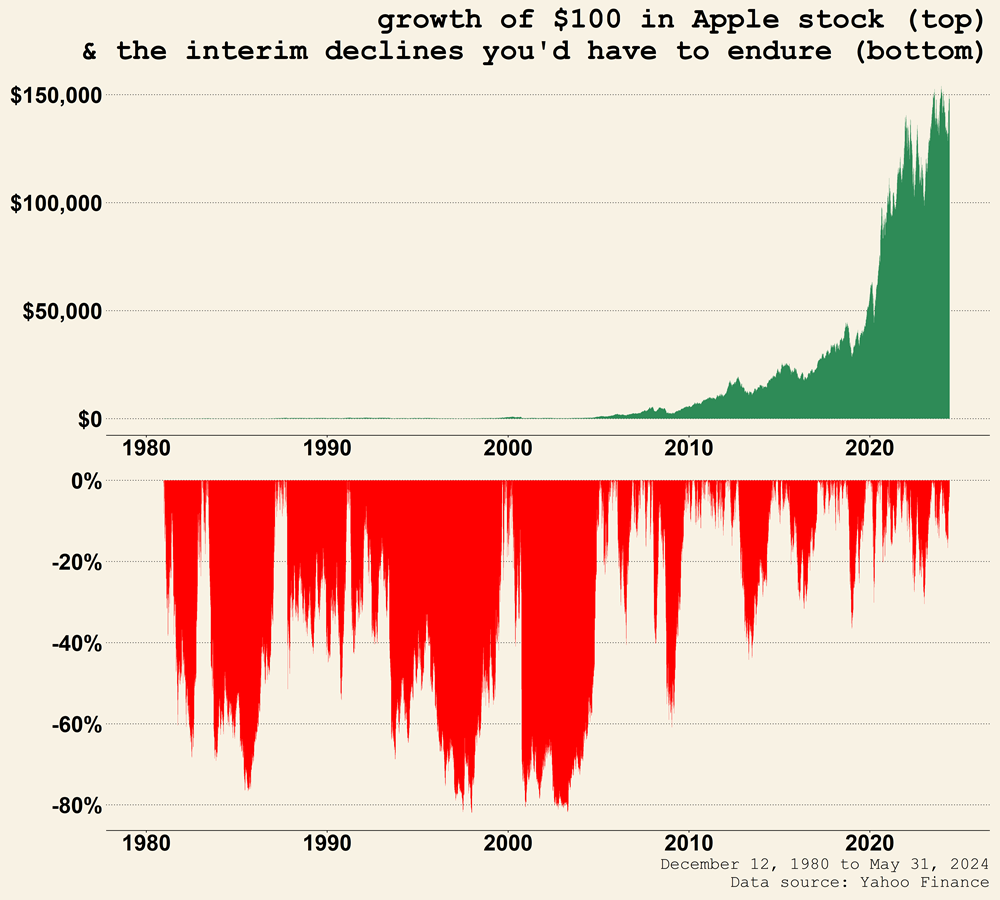
        Apple today is a three trillion-dollar business. A one-time investment of $100 in Apple stock when it went public is worth $150,000 today.

        But I bet none made anywhere close to that kind of money investing in Apple stock. In fact, I am willing to bet that a vast majority of Apple investors lost money or significantly underperformed a global market portfolio during their ‘ownership’ phase.

        How is that possible? How could anyone have lost money investing in one of the best stocks ever?

        Because what none of these stories talk about are the horrendous, business extincting stock price declines you’d have to live through and still come out at the other end holding the shares.

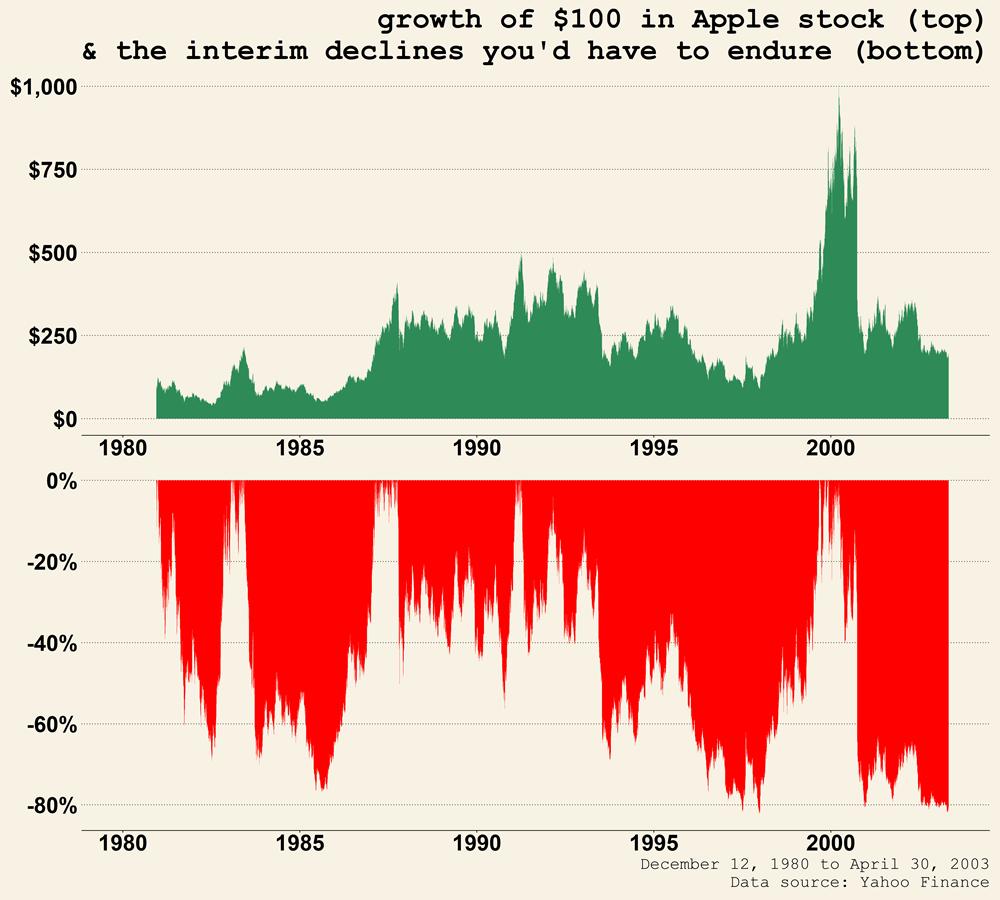
        Let us talk more about Apple. The company went public on December 12, 1980, and within months, it lost 60% of its value. You do see drawdowns (declines) in red in the plot above, but you don’t see much about the $ value performance for the first half of the company’s existence. Zooming in for a better picture…

        Two things stand out:

        • You barely made any money for the first 23 years of being an investor in Apple stock.
        • To add salt to that wound, you’d have to live through numerous forty, fifty and a few eighty percent declines in the interim.

        What does a stock price decline of eighty percent mean? It is a way of the market telling you that there is a significant risk that the business might not survive.

        And that almost came through with Apple. You think you would have hung on through all of that? Not a chance unless of course you get struck with amnesia right after buying the shares (more on this later).

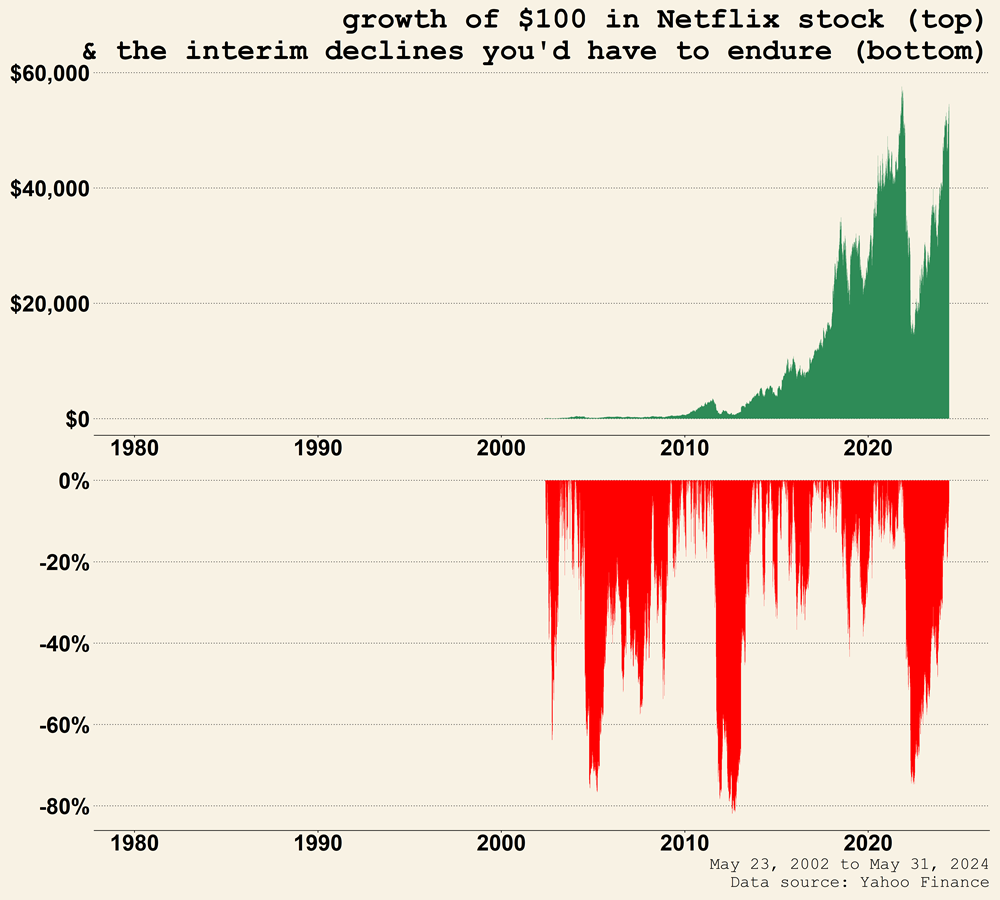
        It is the same story with shares of Netflix.

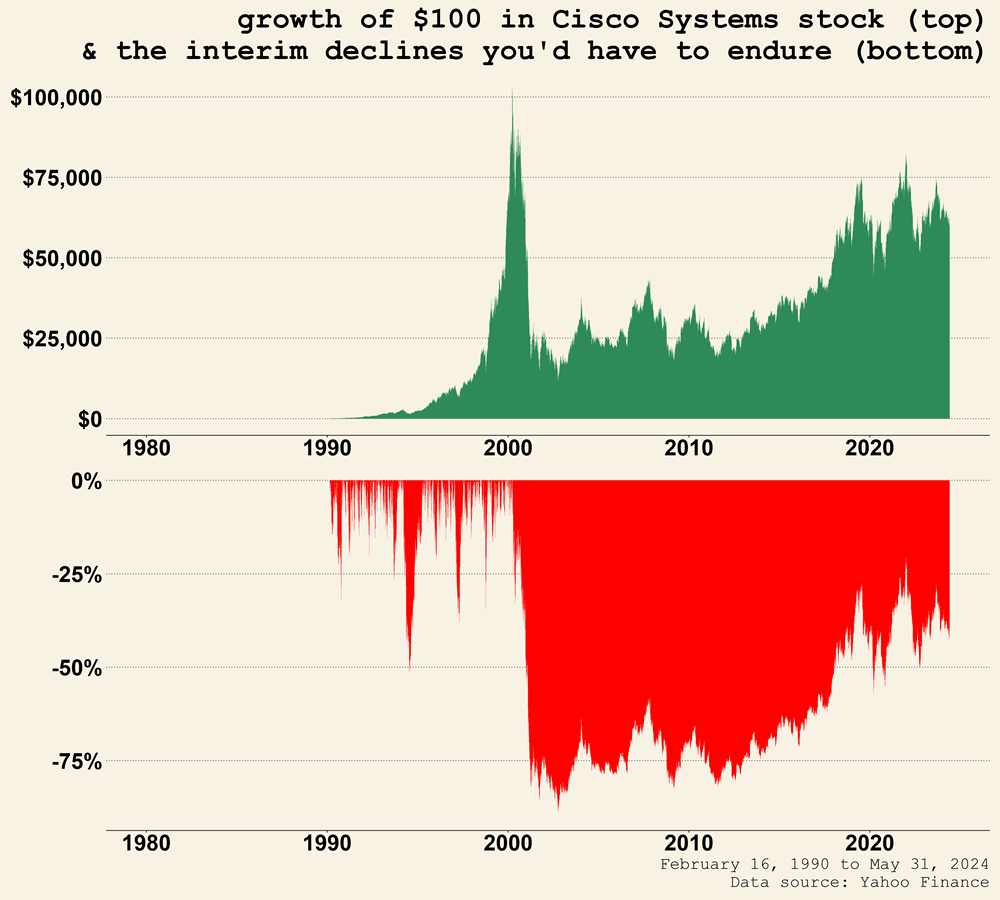
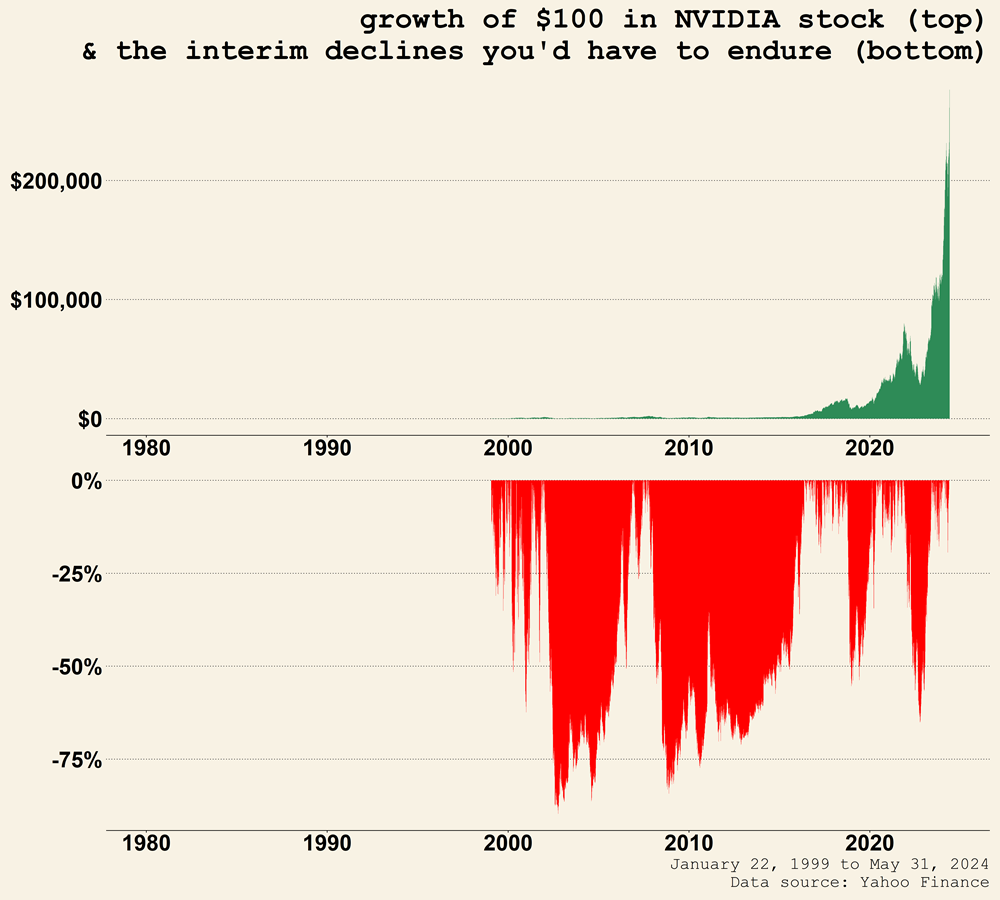
        Nvidia is all the rage these days but so was Cisco Systems back in the day. Similar growth themes were embedded in Cisco Systems stock as they are in Nvidia today.

        Cisco went public on February 16, 1990, and in a mere span of ten years, it became the most valuable company in the world. Had you invested $100 in Cisco stock at its IPO, you’d have $100,000 ten years later.

        Then the Dot-com bubble burst and Cisco has yet to reclaim the highs set twenty-five years ago.

        Talk about Nvidia, you get the same story of living through gut-wrenching declines and then getting extremely lucky to have the growth in AI intersect with their products.

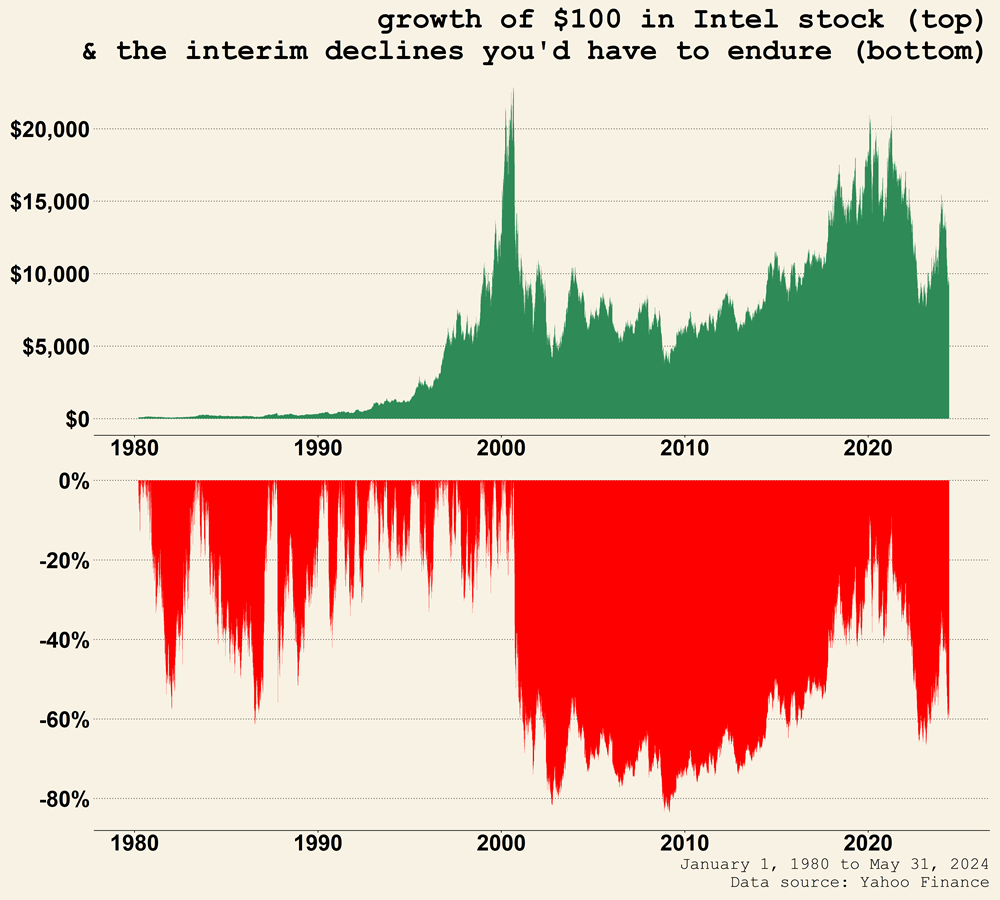
        Or you could have been an Intel investor instead. Same sector eyeing the same set of opportunities but a completely different outcome.

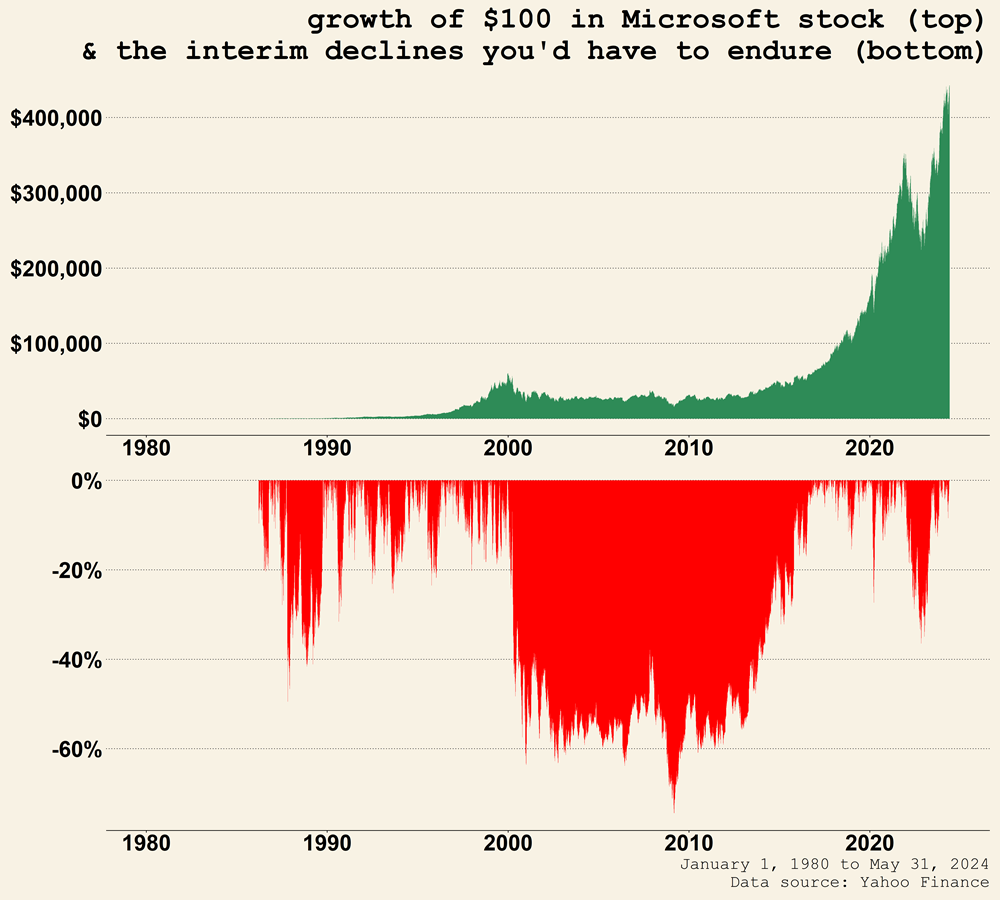
        Microsoft is riding high on the AI wave as well. But had you bought Microsoft stock in March of 2000, you’ll be sitting on dead money for 15 years. That is a literal eternity in the world of investing.

        The point of all these stories is that armchair quarterbacking looks great until you are in the middle of experiencing what it takes to own these stocks.

        So, who is likely to hang on? An extremely lucky person who bought the ‘right’ stock and forgot. Not trying to forget but actually forgot.

        Here is an excerpt from a news story dating back to the Dot-com days that talks about the role luck plays in not only happening into owning the hottest stock of that era but also forgetting to have owned it.

        The man, who lives in Boston, said he purchased 3,000 shares of stock in 1987 on the advice of a cousin. Sometime during the 1990s he sold 2,000 shares of the stock to pay for his children’s college tuition and forgot about the remaining 1,000 shares.

        Some 13 years later, the value of 1,000 shares had ballooned to nearly $4 million.

        The forgotten shares were discovered by the treasury’s Abandoned Property Division. By law, brokerage firms must turn over to the state stocks which show no activity by their owners after three years.

        Forgotten Stock Makes Man Millionaire, ABC News, November 30, 2000

        And all of that before discounting the fact that most companies experiencing big drops in market value never recover. While stocks in aggregate outperform other investments over the long run, most individual stocks don’t. I’ve talked about this study by the Arizona State University professor Hendrik Bessembinder before but let me reiterate some of the key points again…

        • Of the nearly 26,000 companies that went public between 1926 and 2019, only 42 percent of them created net wealth for their shareholders. The remaining 58 percent (15,000 businesses) destroyed wealth in all their existence.
        • Five firms accounted for 12 percent of the total wealth created in the stock market.
        • Eighty-three firms (0.3 percent of the total) accounted for 50 percent of all wealth created.
        • And 1,000 stocks (4 percent of the total) created all the net wealth above what Treasury bills would have paid you.

        Coming into one of these stocks that go on to multiply manyfold in a relatively short amount of time is a lottery type outcome. In fact, it is worse because with a lottery, a winner is declared rather quickly. It is black and white, and it is quick.

        But individual stocks that go on to deliver lottery type outcomes can take decades. And you have to persevere through the interim roller-coaster of heartaches and ulcers.

        So, when you hear these what-if seductive stories, remember that there is a huge amount of survivorship bias built into them. Do not let these stories sway you away from your plan.

        Cover image credit – Jon Collier, Flickr

      • Adding Fuel To Fire

        Adding Fuel To Fire

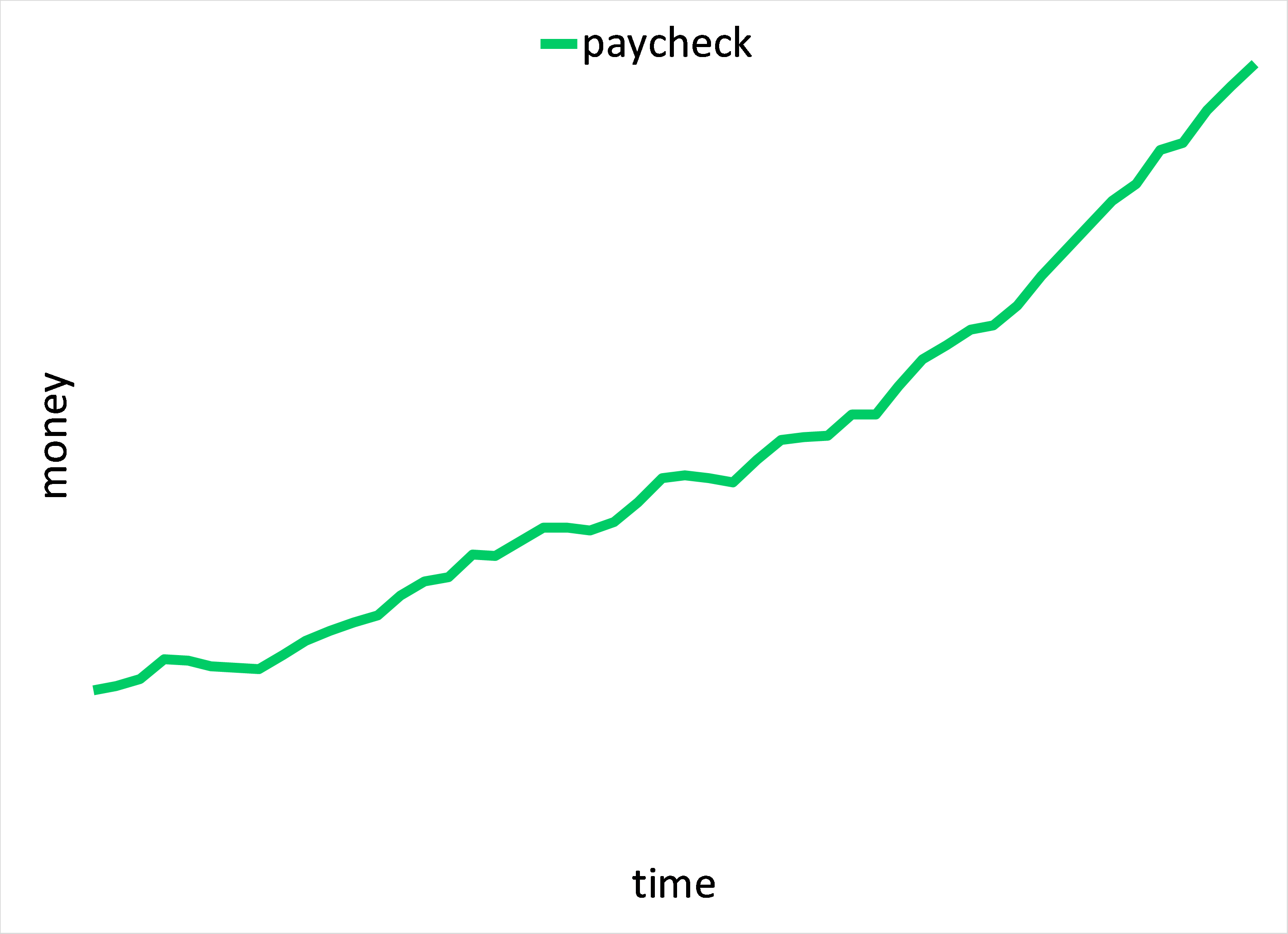
        Mary Hunt profiles three types of people in her book 7 Money Rules for Life on how they handle money and how it impacts their well-being and happiness.

        So, say they all made the same kind of incomes since they started working…

        Nothing spectacular. Their paychecks rose as the cost of living (inflation) rose. But a big chunk of their paychecks rising came from them honing their respective crafts in a field the economy values.

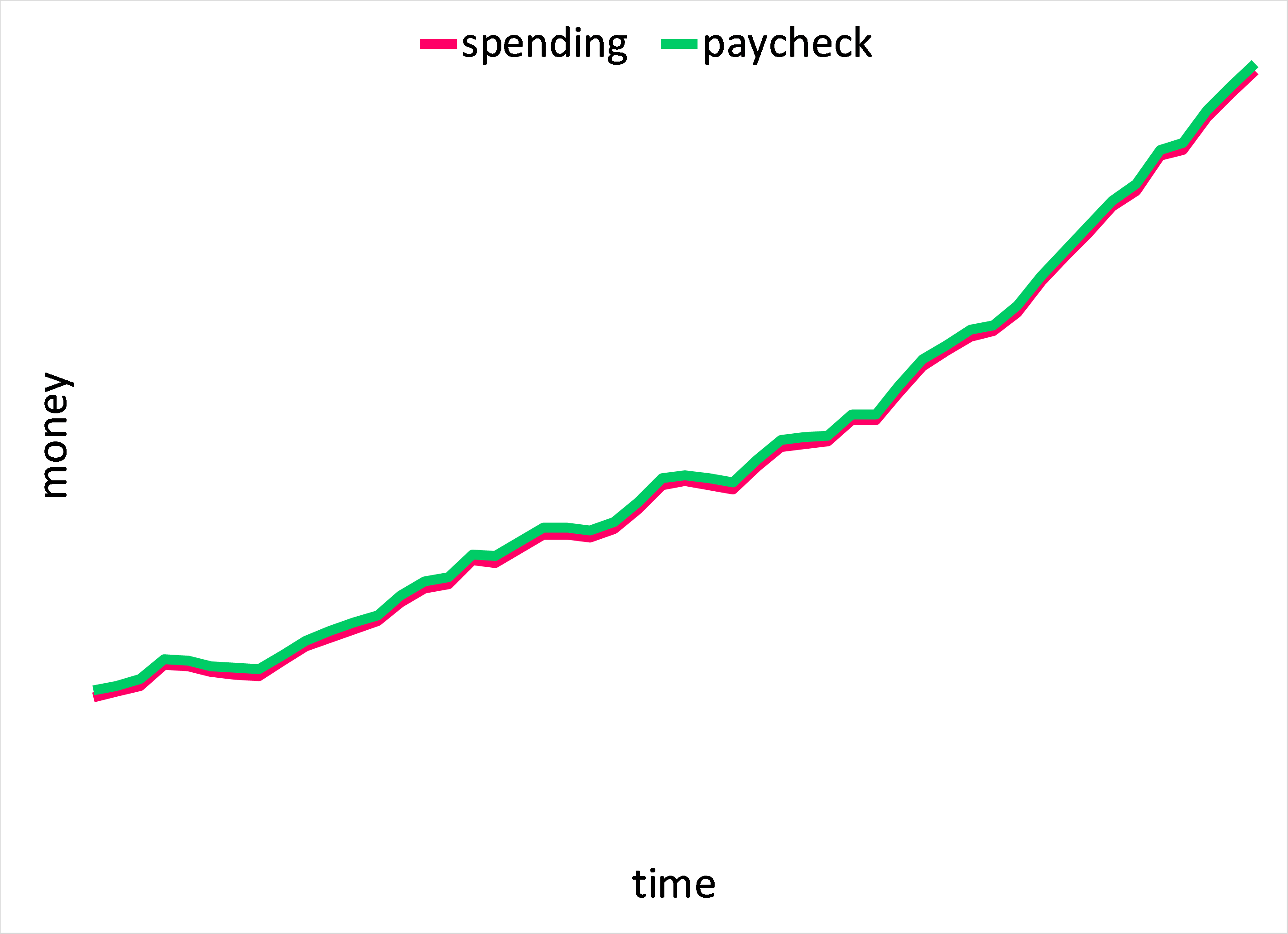
        To that income, we now add spending…

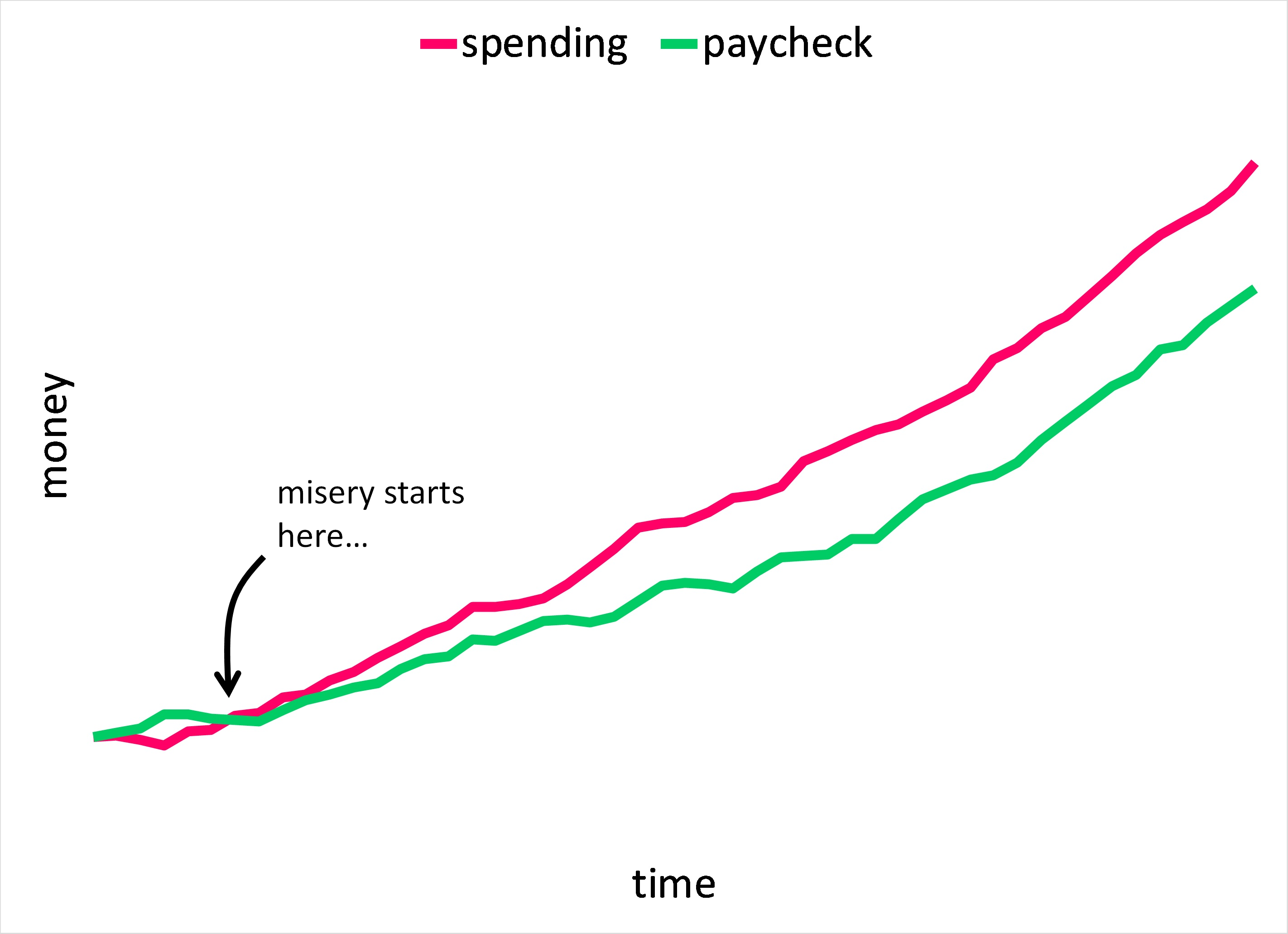
        This is the first category of people Mary Hunt profiles. Their spending rises as their incomes rise – classic lifestyle inflation. They are doing great in the now and yet are a paycheck away from becoming debt slaves. A good life is hard to give up on.

        And when the outflow of money is more than the inflow, misery is what we get.

        Talk about misery, economist Daniel Kahneman differentiates between what he calls momentary happiness and happiness that is deeper and longer lasting.

        Momentary happiness comes and goes. A good night out with friends makes you happy in the then. But the memory of that night eventually fades, and you are back to your initial state.

        Lasting happiness, as Kahneman describes, is about life satisfaction. It is built over time through achieving goals and building the kind of life you admire. It is when you get to do your life’s work, free from the financial pressures of doing that work.

        So, from the happiness perspective, it is life satisfaction we are after. And if you are lucky, you’ll find your life’s work in the work you are already doing. And if the money is decent, wealth building then becomes a side show. You still need a plan but there is no hurry.

        But if you haven’t found your life’s calling, your job number one should be to get to a base-level wealth that generates enough passive income as quickly as possible. And then you can go explore how you want to spend your time.

        Charlie Munger once said that like Buffett, he had a considerable desire to get rich – not because he fancied mansions or Ferraris. He wanted independence. He wanted to control his time the way he wished, which is what wealth allowed him to do.

        There is this tiny movement of die-hard minimalists who want to bag work in their forties. It goes by the name of FIRE or Financial Independence, Retire Early. Folks in the FIRE camp, though not Munger-rich, have the same Munger mindset. They are the engineer-types, making good incomes but what sets them apart and what sets them free early in life is their ability to sock away half of what they make into savings and investments.

        This is what Mary Hunt describes as the third category of people. Though they set themselves up to retire early, they are not the types who give up on work. These are driven folks. Most continue working but now they get to work on their own terms. It circles back to that happiness construct around life satisfaction and having a sense of control.

        Use money to gain control over your time, because not having control of your time is such a powerful and universal drag on happiness. The ability to do what you want, when you want, with who you want, for as long as you want to, pays the highest dividend that exists in finance.

        Morgan Housel

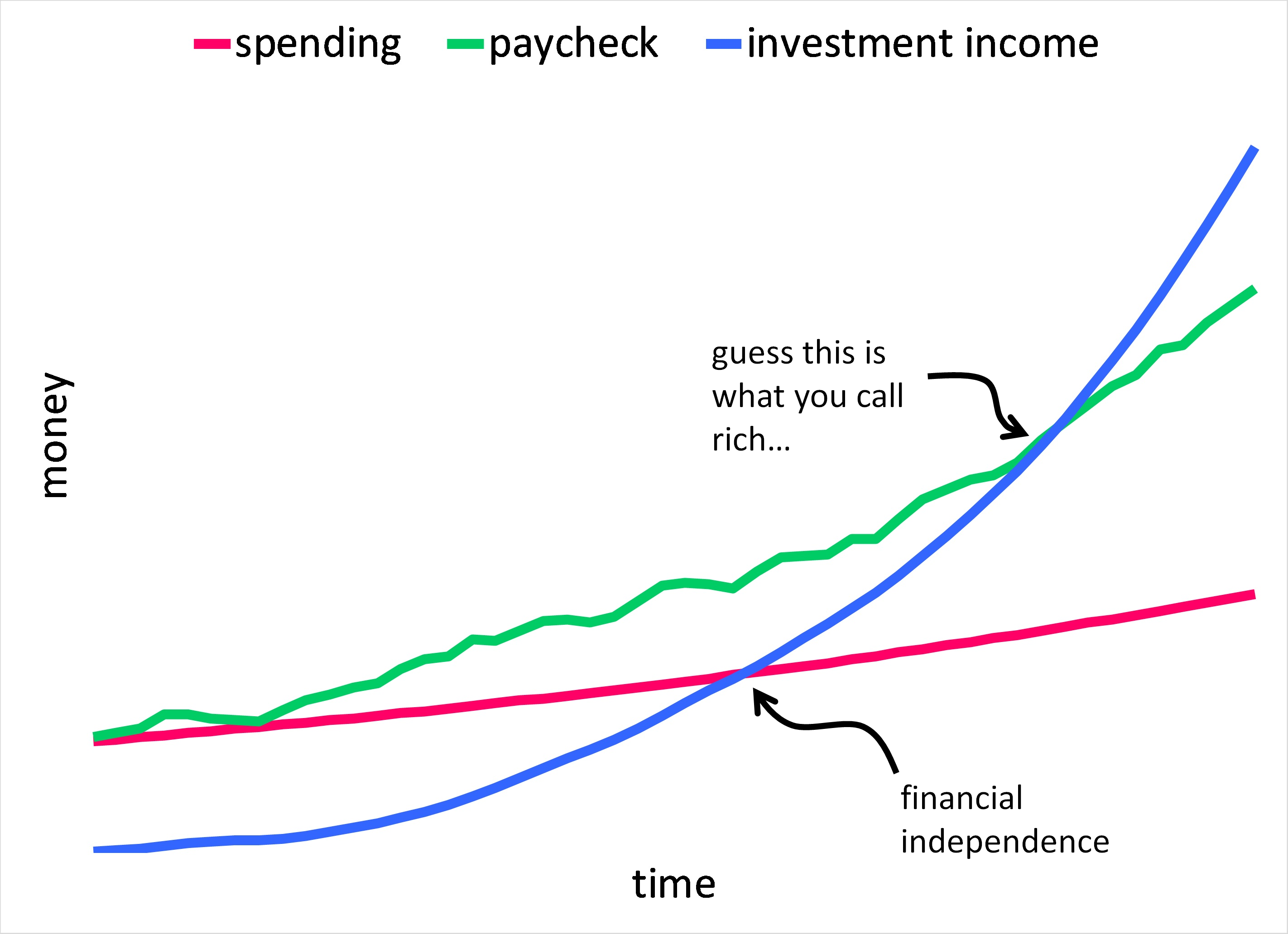
        And it is not like you have to commit to a lifetime of pinching pennies to get to financial independence. You can get there even after baking in a good deal of lifestyle inflation as shown by the gradually rising red curve above.

        What you do not want are dramatic ups and downs in spending as your income changes. That is a stressful way to live not to discount the untold amount of psychological damage it does to kids growing up in that environment.

        So, where is the most difference you can make on your journey towards financial independence? More income for sure helps but only when spending is kept in check.

        NYU professor Scott Galloway talks about a friend of his who runs a 700-person division at a large investment bank. He makes somewhere between five and nine million dollars a year. Between paying for New York city taxes, alimony to his ex-wife, home in The Hamptons and a master of universe lifestyle, he spends almost all of it. He describes him as poor.

        Prof. Galloway‘s father on the other hand, between his Royal Navy pension and income from Social Security makes $58,000 a year but spends forty-eight. He describes him as rich. He has got passive income greater than his burn. That is the definition of rich.

        Rich is a function of not having to worry at night that the music might stop. And if the music were to stop, you can support your lifestyle without working.

        So where is the biggest dent you can make with spending? Housing of course takes up the lion share. Then cars and then comes the other itty-bitty stuff.

        Personal finance experts love to rail against spending on the itty-bitty stuff that in the grand scheme of things is inconsequential while the biggest boondoggles of the monthly spend remain unaddressed.

        And a lot of it comes down to being able to differentiate between needs versus wants.

        Let us go back to housing for example. In the 1950s, the average new home was a thousand square feet. By the 1970s, that home size grew to 1,700 square feet and these days, it is around 2,600 square feet. All this while, the average family size dropped from 3.5 people in the 1950s to 2.5 people today.

        So, we have less people living in almost 3x the amount of living space. That is a lot of extra spending that could instead be used as a fuel to shorten the path to financial independence. That does not even count for all the more we pay on everything – property taxes, insurance, electricity, water plus all that time spent cleaning and maintaining that extra space.

        Big homes also mean more stuff so a perpetual drain on our wallets from all angles.

        And cars? How did we normalize buying $50,000 cars?

        Most of the needless spending we get seduced into doing is all due to our attempts at keeping score. We want to live, drive and dress better than our neighbors or whoever we get into this comparison game with.

        Comparison is the death of joy.

        Mark Twain

        Carol Graham in The Pursuit of Happiness talks about what constitutes the economics of happiness. Stable marriage, good health and enough income is what it takes to be happy.

        What? Is income ever enough? Why would making more money not make us happier?

        That is because the relationship between money and life satisfaction is not linear. Income matters to well-being only up to a point. Beyond that, other people’s incomes start to matter more. So, a rise in other people’s income hurts our happiness. That of course is dumb.

        The truth is that folks with enduring personal finance success are inclined to not give a hoot about what others think about them. And this is where our focus in life should be if happiness and life satisfaction is our goal.

        On the surface, personal finance looks like a field that helps you optimize money. Once you peel back the layers, you see that it’s actually a field that helps you optimize happiness. Money is simply the tool it uses to do so.

        Morgan Housel

        And finally, this tweet. It says in a few words that I’ve been trying to say all along.

        A big part of happiness is reaching FI (financial independence), and FI is mostly a function of being happy with what you have, spending less than you make and letting time and compound interest do the heavy lifting. Plus, relationships and experiences but never things.

        Thank you for your time.

        Cover image credit – Pixabay