Author: OnceUSave

  • Recency Bias

    Recency Bias

    Americans afraid of flying overwhelmingly took to the nation’s highways in the immediate aftermath of the September 11 terrorist attacks. But flying as we know is much, much safer than driving can ever be. Our odds of getting killed in a plane crash – one in a million. Our chances of dying in a car crash – one in five thousand1.

    Or take a lawyer’s closing arguments. What is the jury most likely to remember? How strong of a case the defense makes versus prosecution right before the jury deliberates.

    Here is one more…what your boss remembers about your work influences to a considerable extent the performance review you’ll get. Unfair but unless they really work at it, this generally holds true.

    And what is your boss most likely to remember? Your recent impactful work.

    These are all examples of recency bias. We give greater importance to recent events over the historic ones because our brains like to take shortcuts. Thinking and number-crunching is hard.

    But these attempts at taking shortcuts take a terrible toll on our money because as they say, those who do not remember history are doomed to repeat it.

    Take investors piling into hot investments du jour for example. I mean it feels natural to want to own what has done well lately and letting go of what hasn’t.

    But in a portfolio of uncorrelated investments which is what you should strive to own, there will always be investments that suck. And sometimes they’ll suck for a long time.

    But assuming you own investments that are bound to eventually recover, this is your chance to add to the holdings that are temporarily in the suck zone.

    We won’t do that though. Because when an investment is not doing well, we assume it will continue to not do well. Recency bias again.

    They say elephants never forget. We must never forget. Never forget about the boom-and-bust investing strategies of Gerald Tsai, a mutual fund manager who rose to fame during the electronics boom of the 1960s.

    But as it is with most booms, investor capital follows by the truckload which leads to a bunch of malinvestments which then eventually causes that boom to go bust. It did for Mr. Tsai as well and his investors suffered the consequences.

    We should never forget about Garrett Van Wagoner, deemed the Warren Buffett of the Dot-com era. He ran his namesake Van Wagoner Emerging Growth fund that earned 66 percent a year for three straight years. It turned a single ten-thousand-dollar investment into forty-five thousand dollars.

    But as is typical of most hot streaks that are often mere statistical anomalies, investors’ money follows by the truckload (again) and as always, much too late in the cycle. It did for Mr. Wagoner‘s fund as well with assets under management exploding 100 times in three short years to 190 billion dollars, as clear an example of recency bias as there can ever be.

    Then the bubble burst. The tech-heavy NASDAQ fell from a peak of 5,000 points in March of 2000 to a low of 1,100 points by October of 2002, a stunning 78 percent peak to trough decline for those keeping score. That is the nature of concentrated bets.

    NASDAQ would continue to trade below that peak until 2015. That is fifteen long years of waiting but we don’t remember that. It wasn’t all that bad had you continued to dollar-cost average into that investment, but no normal earthling ever does. And concentrated bets sometimes never recover.

    The Van Wagoner Emerging Growth fund not only retraced the entire rise but when all was said and done, the fund earned a negative 8 percent a year from its inception in 1996 to its eventual demise in 2008. That is a cumulative loss of 65 percent of investors’ capital for the fund’s entire existence…before accounting for inflation of course.

    But most investors, again due to recency bias, likely piled in at the peak so their losses were far, far worse.

    We also must never forget about Ryan Jacob‘s Kinetic Internet Fund that he ran from 1997 to 1999. The fund earned 13 percent in 1997, 196 percent in 1998 and 216 percent in 1999, turning a single ten-thousand-dollar investment into $105,000 by the end of 1999.

    Ryan left Kinetic to start his own fund, The Jacob Internet fund right at the peak of all things Dot-com. Investors’ money followed by the truckload (again) expecting that hot streak to continue.

    But then the bubble burst. His new fund lost 79 percent in 2000, 56 percent in 2001 and 13 percent in 2002. That same $105,000 at the peak, had you followed him into his new fund, would be worth $8,300 at the bottom, a 92 percent peak-to-trough decline in three short years.

    So, with that as a backdrop, how could we have not seen the train wreck that is Cathie Wood’s Ark Innovation fund? Or the egregiously valued tech stocks with catchy storylines that investors continue to pile into because this time is different?

    This time is never different. It usually takes a generation of investors to forget about the last bubble and repeat the folly all over again. But repeat they will because of recency bias.

    Some takeaways, hence…

    • Never own a hot fund because by definition, it must be concentrated. And once that hot fund becomes cold, it will likely remain cold forever. Markets will recover but concentrated bets into bubble investments seldom do. If you must, buy it after it has cooled off, so you aren’t a victim of performance chasing. And no matter how compelling an argument the fund manager makes, think twice before overdoing it.
    • Be mindful of what the stock market, one of the highest yielding of all investments as a category usually delivers over the long term. If you have an investment doing better than that, ask why. There is no free lunch anywhere, especially in the world of money.
    • A business is a business. It must eventually adhere to the fundamentals of revenues and profits and cash flows, not some pie in the sky dream. So, when you are thinking of buying a stake in that business, try to find out why it is worth what it is worth. Because even if that dream were to be eventually realized, it does not mean you’ll get anything out of it if you paid too much for that business.
    • And making investment decisions based on outcomes is a classic mistake we make. Always think about the process. If the process is not right, no amount of return matters. Because it will eventually blow up. Get the process right and things will fall in place.

    Thank you for your time.

    Cover image credit – Roger Brown, Pexels

    1How Flying Today Is Safer Than At Any Time In The Past by Joanna Bailey & Riley Pickett, Simple Flying, September 8, 2022.


  • Let Prognosticators Pontificate

    Let Prognosticators Pontificate

    Joseph Granville was in the business of prognostication. He was a stock market maven. He knew precisely what to buy and when to buy. He moved markets.

    And he let it all know in a newsletter he published called the Granville Market Letter. In that, he gave specific instructions on whether it was time to buy or sell. He had thousands of paying subscribers who would hang on to every word he said.

    In his own words…

    I’m paid to put you in at the bottom and take you out at the top.

    Joseph Granville

    In his January 7, 1981 newsletter, just like many times before, he advised his subscribers to sell everything and go short the market. If you don’t know what going short means, you don’t need to know.

    His followers heeded that advice. The next day was a massive down day for the stock market.

    But what his followers did not know at the time is that that was THE time to be buying stocks. The day he made that call, the Dow closed at 980 points. And we know where it is at today.

    So, if you got out and stayed out, you lost big. That is not counting all those dividends you would have collected along the way that you would have of course parlayed into buying more shares. Add all that up and you’ll be massively depressed.

    Mark Hulbert, who writes the Hulbert Financial Digest, chronicles the performance of several investment advisory newsletters from time to time. He estimated that from 1980 to 2005, Mr. Granville’s stock tips lost his followers half a percent a year for twenty-five straight years. That is when the market delivered 12 percent annualized gains.

    And his tips for his most aggressive traders basically wiped them out.

    Mr. Granville died in 2013, never reversed himself and stayed bearish all along.

    Nouriel Roubini, professor of economics at NYU’s Stern School of Business, shot to fame by timely predicting the housing market crash of 2008. That call made him an instant celebrity. His predictions were mostly about all the bad times to come. He was nicknamed Dr. Doom.

    With that newfound confidence, Dr. Roubini gave very specific advice to those contemplating investing during the treacherous days of early 2009.

    For the next 12 months, I would stay away from risky assets. I would stay away from the stock market. I would stay away from commodities. I would stay away from credit, both high-yield and high-grade. I would stay in cash or cash like investments such as short-term or longer-term government bonds. It’s better to stay in things with low returns rather than to lose 50% of your wealth. You should preserve capital. It’ll be hard and challenging enough. I wish I could be more cheerful, but I was right a year ago, and I think I’ll be right this year too.

    Nouriel Roubini

    The Dow gained 23 percent that year, S&P 500 gained 24 percent, and Nasdaq was up 44 percent. Professor Roubini was right about 2008 but not so right about 2009.

    And that is the point.

    Dr. Roubini can of course run circles around all of us when it comes to the economy and the markets, but predictions are what they are.

    And he has a lot of company.

    Bill Gross, who ran the largest bond fund in the world while at PIMCO, announced in early 2011 that he had removed Treasury bonds from its flagship fund stating that bond yields have reached unsustainably low levels1.

    Treasury bonds that year had one of the best years in many years. His thesis was right, but markets often dance to their own tune.

    David Lereah, the former chief economist at the National Association of Realtors, said this in November of 2005.

    The good news is that inventory levels are improving and housing supply will come closer to buyer demand in 2006. We expect a healthy and more balanced market next year.

    David Lereah

    You’d think one could count on his views concerning the future of the housing market.

    House prices started their multi-year decline in the summer of 2006.

    Rich Dad Poor Dad author Robert Kiyosaki made it known about what the stock market was going to do next.

    The current stock market rally will probably turn into a dead cat bounce. If the Dow drops below 6,500 points, 5,000 may be the next stop.

    Robert Kiyosaki

    That was in 2010. And we know the rest of the story.

    Then there is Jim Cramer of CNBC. He likely means well but his predictions are oftentimes so wrong that you can now bet against anything he tells the world to do by buying an Inverse-Cramer ETF. In March of 2008, he said that Bear Stearns as a company was doing fine and there was no reason to worry. Bear Stearns at the time was trading at $63 a share.

    But just six days later, it was sold to JP Morgan Chase for a mere $2 a share.

    Lehman Brothers was rated A-Okay by Moody’s right after the de-facto collapse of Bear Stearns.

    Three months later, the company went under; a company that survived World Wars, recessions and depressions, a company that has been around almost since the founding of this country couldn’t survive the reckless risk-taking that ran rampant on Wall Street and Main Street alike.

    Then there are headlines like these.

    Sell everything ahead of the stock market crash, say RBS economists.

    The Guardian 

    That is a quote by the economists at the Royal Bank of Scotland so not just anybody. Dig a bit deeper into that write-up and they are talking about a potential stock market drop of 20%.

    Really? They want you to sell everything for that.

    That was in January of 2016. Had you acted on any of that, well, you know the story.

    That is not to say that the folks behind these forecasts are not some of the best and the brightest. They indeed are. It is just that forecasting with precision on anything with the economy and the markets is an immensely difficult undertaking.

    Take getting just the future rate of inflation right. You would think it is just one number until you realize the extent of the inputs required to predict anything to do with just that one number. Niall Fergusson captures the incredible complexity involved in this Bloomberg opinion piece. An excerpt below…

    Consider for a moment what we are implicitly asking when we pose the question: Has inflation peaked? We are not only asking about the supply of and demand for 94,000 different commodities, manufactures and services. We are also asking about the future path of interest rates set by the Fed, which – despite the much-vaunted policy of “forward guidance” – is far from certain. We are asking about how long the strength of the dollar will be sustained, as it is currently holding down the price of U.S. imports.

    But there’s more. We are at the same time implicitly asking how long the war in Ukraine will last, as the disruption caused since February by the Russian invasion has significantly exacerbated energy and food price inflation. We are asking whether oil-producing countries such as Saudi Arabia will respond to pleas from Western governments to pump more crude. . . .

    We should probably also ask ourselves what the impact on Western labor markets will be of the latest Covid omicron sub-variant, BA.5.  UK data indicate that BA.5 is 35% more transmissible than its predecessor BA.2, which in turn was over 20% more transmissible than the original omicron.

    Good luck adding all those variables to your model. It is in fact just as impossible to be sure about the future path of inflation as it is to be sure about the future path of the war in Ukraine and the future path of the Covid pandemic.

    So easy it ain’t. Some takeaways hence…

    • Never, ever be completely in or out of the markets based on what you see, read or hear. If you cannot handle the heat, tamper down on the sizzle by adding more bonds. You’ll earn less but it is not going to end your world. But time one of these things wrong and your money world might as well end for a long while.
    • Nobody knows as much as you think they know. Or at least nobody knows as much to predict any of these things right. The world economy is a complex, adaptive system. Everything affects everything. The system is perpetually in motion and when it goes out of whack in some corner of the economy, it self-corrects. That is its nature. Don’t bet on things staying the way they are for long.
    • The best laid financial plans are designed to react considering what has already happened instead of in anticipation of what is going to happen. If your investment strategy relies on predictions – no matter how credible the source – you are gambling, not investing.
    • And last, your plan is your plan. It is based on your situation, your goals, your aspirations and not some sage who is going to right your ship at a point in time. Making changes based on what a billionaire has to say on TV is the dumbest thing you can do with your money. He can lose 90 percent, and he’ll still have 100 million dollars. Not you.

    So, let the prognosticators pontificate all they want. Amuse them, get entertained and then carry on with your life.

    Thank you for your time.

    Cover image credit – Cottonbro Studio, Pexels

    1 The real risk of rising interest rates by Larry Swedroe, CBS News, June 24, 2014

  • Quit Playing The Game You’ve Already Won

    Quit Playing The Game You’ve Already Won

    Steve Jobs and Steve Wozniak co-founded Apple. We all know that.

    What many don’t know is that there was a third co-founder. His name was Ronald Wayne. The reason we don’t hear much about him is because he quit Apple just two weeks after the company was formed. He then sold his 10 percent stake in the company for a mere $800. Had he not sold…well, we know the story.

    But then consider his situation at the time. He had a family to support and bills to pay. Working on an unproven product in a scrappy startup was not the ideal of stability, at least for him.

    When asked about “why he quit” decades later, he said that he made the best decision with the information he had at the time.

    And that is the right way to look at it. It must be.

    We can do Monday morning quarterbacking all day long but that is the right way to approach decision-making in many scenarios we face in life.

    On a tangentially similar note, say you come into a windfall, planned or unplanned, and that windfall is big enough to cover your forever expenses. The windfall could be an outcome of a startup you had a stake in that IPOed at an unbelievable price.

    Or an accidental stock pick which you then forgot about, and which later turned into a goldmine that gave you that lottery-like outcome.

    Or you slowly and methodically scaled up to that windfall through regular savings and investments, just like what 99 percent of us do.

    Whatever the case, you now have a decision to make. What should you do? Money wise, you are done with the slaving.

    And if you are done, if you’ve won the game, why keep playing? Yes, more money would be nice but if that comes with the risk that could make you go back to slaving, that is no good.

    When you’ve won the game, it is not just money that is at stake. It is time. It is freedom to do what you really aspired to do with this one precious thing called life. That is what’s at stake. What else would you be doing with your time is at stake if money was no longer an issue.

    So how do you know if you’ve won the game? We’ve all heard of the four percent rule. That is, if you can cover your annual living expenses with four percent of your money, you are technically done. You’ve won the game. Because if you’ve designed your life and your money right, you in theory will never run out.

    But I like to plan a bit conservatively, especially considering today’s interest rates and market valuations. I’d shoot for the three percent rule.

    But if leaving rich heirs behind is your goal, I’d use the two percent rule. I know many of you are, knowingly or unknowingly, in this camp or scaling up to be in that camp because I see the numbers.

    But the two percent rule means saving up to a target net worth of 50 times your annual living expenses. So, if you spend $50,000 a year, you’ll need to save up to a $2.5 million portfolio.

    That appears big but is doable assuming you have a reasonably long runway.

    The biggest hurdle though in trying to win this game is not numbers. It is you and me. Because as author Morgan Housel says, the hardest and the most important financial skill is getting the goalpost to stop moving. And that is a skill most cannot master.

    But if you can get that goalpost from not moving, you are done. Not done working but done working on somebody else’s terms. That is the essence of financial independence.

    Some takeaways hence…

    • Blindly chasing more growth without weighing underlying risks is what gets us into trouble. Your life situation, your goals, your aspirations are unique to you. Your financial plan and the portfolio that feeds into that plan, hence, should match that uniqueness. Just because your neighbor does some random thing with his savings does not mean you need to follow him.
    • Your expenses dictate everything. Do not let them creep up more than they need to because that independence that you so desire might not ever come, no matter how much money you have.

    Thank you for your time.

    Cover image credit – Vlad Chețan, Pexels

  • A Tale of Two Speculators

    A Tale of Two Speculators

    Edwin Lefèvre in Reminiscences of a Stock Operator, a 1923 pseudo-fictional novel, chronicles the life of Jesse Livermore, a real person who was a stock trader par excellence of the time. He made and lost fortunes many times over but ultimately and tragically ended up taking his own life.

    Jesse Livermore went from being one of the richest people in the world, made famous by a timely call shorting US stocks right before the crash of 1929. Shorting stocks is an extremely risky strategy that profits from stock price declines. Never short stocks because people buy stupid investments at stupider prices all the time. Even if you are eventually proven right, it could be way after you were margin-called into liquidation.

    But then we are talking about the great Jesse Livermore. He made $100 million overnight in 1929 dollars, shorting stocks in what amounted to one of the greatest trades ever.

    A mere decade later though, he was bankrupt. The ensuing stress and misery likely killed him. This story unfortunately repeats itself time and again with most lottery-like outcomes.

    A few of the best excerpts from the book that relates to the topic at hand…

    The sucker has always tried to get something for nothing, and the appeal in all booms is always frankly to the gambling instinct aroused by cupidity and spurred by a pervasive prosperity. People who look for easy money invariably pay for the privilege of proving conclusively that it cannot be found on this sordid earth.

    Edwin Lefèvre in Reminiscences of a Stock Operator

    Andrew Carnegie, the 19th century steel baron said something along the same lines (not from the book)…

    There is scarcely an instance of a man who has made a fortune by speculation and kept it.

    Andrew Carnegie

    And that is because there is a defect with our wiring. We love easy money. And we think we can keep the wins coming so we get overconfident with whatever seems to be working so we bet more.

    But it was all luck what we thought was skill and suddenly it is too late. The bubble eventually bursts.

    And it is especially dangerous when lady luck shines on us early in our investing lives. I know someone who made 10 times his money in less than a year playing crypto.

    What happens to him now? None of what is real investing that counts dividends and interest and cash flows will sound exciting. Because exciting it is not.

    Excitement with investing is like sitting on a powder keg of explosives. Sooner or later, it will blow up. More on that later but back to a few more quotes from the book…

    The desire for constant action irrespective of underlying conditions is responsible for many losses in Wall Street even among the professionals, who feel that they must take home some money every day, as though they were working for regular wages.

    Edwin Lefèvre in Reminiscences of a Stock Operator

    This was written in the 1920s. Nothing has changed.

    And take home some money every day? That is a typical day trading mindset. Exchanging pieces of paper is not a job, just like playing poker is not.

    Day trading is and will remain a zero-sum game and that is before taxes and fees. After accounting for those costs, it is a guaranteed money loser. Don’t waste your life doing it.

    And very reluctantly change anything with your money based upon short-term market events. It is one thing to start with a set of assumptions and intelligently change them in light of new data but it is a completely different ball game to change anything with your money based upon whims, rumors and FOMO (fear of missing out).

    So, once you’ve got a solid financial plan, any big changes to your money is in fact a sign of instability. It is a sign of a lack of conviction. And once you lack conviction, you’ll guarantee bail the next time the market crashes and then you are done.

    But back to another quote from the book…

    Speculators buy the trend; investors are in for the long haul; “they are a different breed of cats.” One reason that people lose money today is that they have lost sight of this distinction; they profess to have the long term in mind and yet cannot resist following where the hot money has led.

    Edwin Lefèvre in Reminiscences of a Stock Operator

    This last one rings especially true considering what economist Charles Kindleberger once said…

    There is nothing as disturbing to one’s well-being and judgement as to see a friend get rich.

    Charles Kindleberger

    Do not let envy override a good financial plan regardless of how imperfect it might seem to appear at any given time.

    They say you never grow poor taking profits. No, you don’t. But neither do you grow rich taking a four-point profit in a bull market.

    Edwin Lefèvre in Reminiscences of a Stock Operator

    So, you doubled your money buying some random investment. I say great. How much did you bet? If it was not a life-changing amount, why did you bother?

    And say you did invest in something that you believed in but cannot muster the courage to double or triple down when that investment temporarily flounders because flounder it will, why did you own it in the first place?

    A man must believe in himself and his judgment if he expects to make a living at this game.

    Edwin Lefèvre in Reminiscences of a Stock Operator

    Wall Street Bets, a Redditt community where investing for a week is considered long-term and a year, an eternity, had someone post that he did 20 times his money in four years, a story you’d find mostly at bull market peaks. That poster’s investment strategy…

    He said that he usually focuses on a single position, sometimes as much as 90% of his portfolio will be concentrated on his conviction pick. At the moment, he’s “the most diversified” he’s ever been, with his portfolio split between AMD and Norwegian Cruise Line.

    Investor turns $100,000 into $2.2 million — now he’s banking on a cruise line to reach his early retirement goals by Shawn Langlois in MarketWatch

    So, he bet, and he won. Just like he would have had he gambled in Las Vegas. Do not try this at home because just a week later, in another piece coincidently written by the same author about another Redditter with the exact opposite and probabilistically more likely outcome…

    Italian trader loses his ‘entire life savings’ on one insanely risky position.

    Italian trader loses his ‘entire life savings’ on one insanely risky position by Shawn Langlois in MarketWatch

    His investment strategy…

    Yes, StopFapForever, who claims to be a 28-year-old Italian, shared his brutal market mistake with the bunch on WallStreetBets. He apparently went all-in on Luckin and lost his entire life savings in the process. “Now I’m broke af,” he wrote.

    After getting hammered overnight, he shared the expensive lesson he learned. “I’m gonna just invest in ETFs, gold and bonds for the rest of my hopefully long but quite useless life,” he said.

    Italian trader loses his ‘entire life savings’ on one insanely risky position by Shawn Langlois in MarketWatch

    And when you buy an investment, there is always a seller at the other end. If someone doesn’t sell, you cannot buy.

    And with more than 90% of the trading done by institutions, that seller is likely a Goldman Sachs. Or Carl Icahn. Or some hedge fund who lives and breathes these things every waking hour. You think they’ll let go of a potentially profitable investment that easy?

    So, you better have a real good reason to buy that someone as skilled as they are selling.

    But say you still feel compelled to seek excitement with your money. I wouldn’t do it but if you must, slice off a tiny portion of your money and have at it.

    And keep it away from polluting the rest of your money. Start with today and take say five percent of what you own and never add to it. When it is gone, it is gone.

    And hopefully with it will go that desire to speculate.

    Thank you for reading.

    Cover image credit: Javon Swaby, Pexels

  • Gold Is Not An Investment

    Gold Is Not An Investment

    Before the Great Depression of 1929, the United States experienced a mini, almost forgotten depression towards the tail-end of World War 1 (1920-1921). That mini depression was partly caused by the government slashing its expenses to balance its budget considering the wartime debt the country took on.

    That plus rapidly rising prices brought upon by pent-up demand caused by the returning soldiers forming families meant inflation was running hot. That then forced the relatively nascent Federal Reserve to jack up interest rates in the middle of a deep recession. Which then caused the mini depression.

    Somewhat similar decisions were made during the actual Great Depression of the late 1920s. The Federal Reserve then failed to act as the lender of last resort to the failing banks.

    Plus, the mistake of raising interest rates amid that calamity is what turned that depression into the Great Depression.

    At a 2002 conference to honor economist Milton Friedman on his 90th birthday, Ben Bernanke, an avid student of the Great Depression who will later go on to run the Federal Reserve had this to say:

    Regarding the Great Depression…we did it. We’re very sorry. We won’t do it again.

    Bernanke that day acknowledged publicly what many economists have long believed – the Federal Reserve’s mistakes at the time contributed to the worst economic disaster in American history.

    So, with that as a backdrop, every time an economic mess ensues, the central bank in this country and banks around the world jump into action by backstopping whatever caused that mess.

    And that generally means spending by increasing the money supply in some form or the other. Some say this is socializing losses and privatizing profits but that is the system we have for now. No one wants a repeat of the Great Depression.

    But when that new money floods the system and starts chasing a fixed amount of stuff, prices rise (inflation ensues).

    And that is when we see gold bugs come out of the woodwork to prop up the ‘only’ bastion of inflation-hedge that exists, according to them.

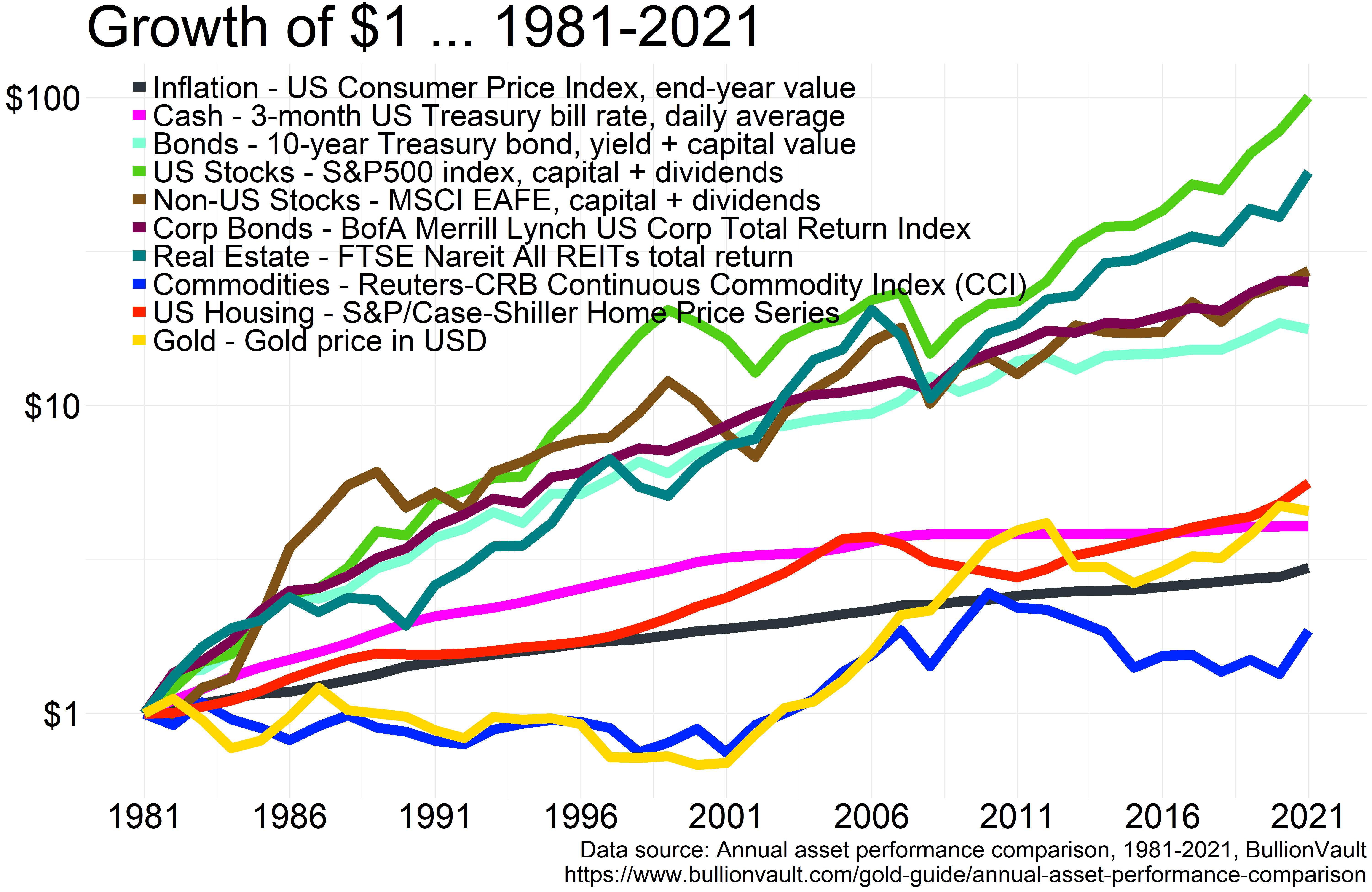
    But is gold an inflation-hedge? The data proves otherwise.

    It must be an investment then? But what is an investment? Or better yet, how do we value an investment?

    The value of an investment today is the sum total of all the profits that investment is going to produce out into the future, discounted to the present at an appropriate discount rate.

    And since gold does not produce profits, it is not an investment. It cannot be an investment. That is regardless of what price it trades at today or will trade at in the future.

    Plus, it costs money to buy (everything does) but then it costs even more to store and protect.

    And when it comes time to sell that supposed investment, all we are looking for is for someone to come along and pay a price higher than what we paid for it. That is a classic Ponzi-like situation. Gold’s investment thesis is all belief with no underlying anything.

    One more quick glance at the plot above (the y-axis is log-scale) and we see a clear segmentation between two sets of curves. The top set is what I would categorize as investments. They include stocks, bonds, and real-estate investment trusts (REITs) which are like stocks that happen to own cash flowing rental real estate.

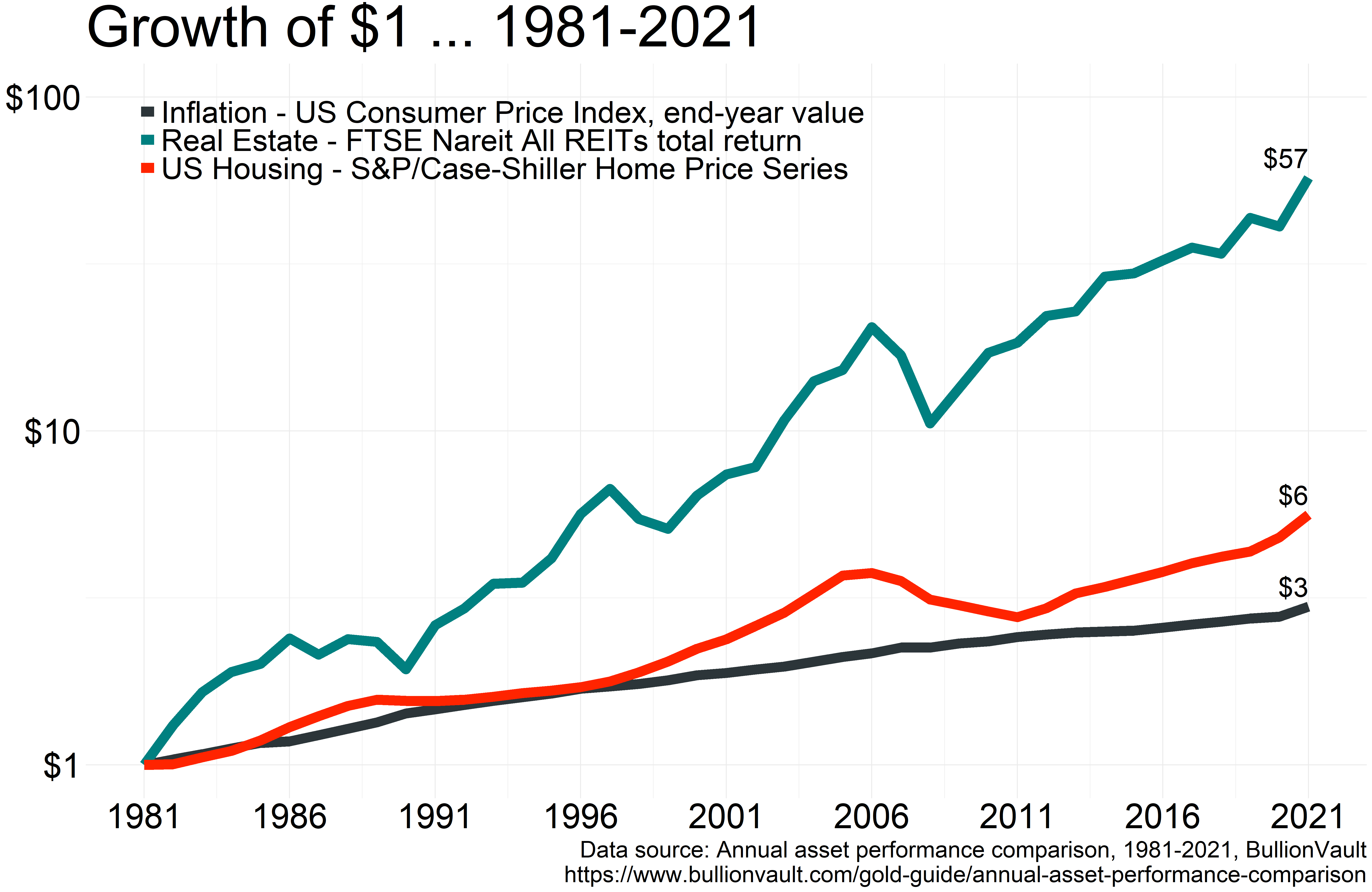
    The bottom set of curves are mostly consumption items. They include cash, commodities, gold (a subset in the commodities space) and housing. Cash and commodities barely matching inflation is expected. But housing? We are told our homes are investments.

    They are not. And they should never be allowed to become investments.

    Homes as investments stagnate economies, induce sprawl and cause misery all around. And they can eventually end up as somewhat Ponzi-like situations because expensive housing impacts family formation.

    And when we don’t have new people replacing the old, we run out of people who’d buy the homes we own. You want to see a live example of how that eventually plays out, just look at Japan. And South Korea. And Hong Kong. And China and someday the whole-wide world.

    Back to housing in the data above, that is looking at housing in aggregate, not that one piece of property in San Francisco. And beyond a certain price point, even San Francisco becomes unsustainable. We cannot make life for businesses harder, which is what expensive housing does.

    There were far too many curves in the data above but just to reiterate that point, I have separated out inflation, the performance of REITs and housing.

    So, a big difference.

    But why do REITs outperform housing by so much? The underlying asset is similar (not the same) so what explains the difference?

    I think one big reason that REITs outperform housing is because REITs are businesses (stocks) that just happen to own rental real estate. But structurally, they are still run like businesses.

    REITs don’t fall in love with the properties they own. The numbers must work. Either there is a return on an investment or there is not. Mostly rational actors making rational, business-like decisions.

    We don’t act the same with our homes because we don’t just treat our homes as investments. We fall in love with them. And we tend to overdo everything once we have fallen in love.

    Also, REITs don’t just own apartments. They also own warehouses, datacenters, office parks, hospitals, shopping malls…literally, any building you are likely to be in besides an owner-occupied home. If you see a structure, assume there is a REIT behind it.

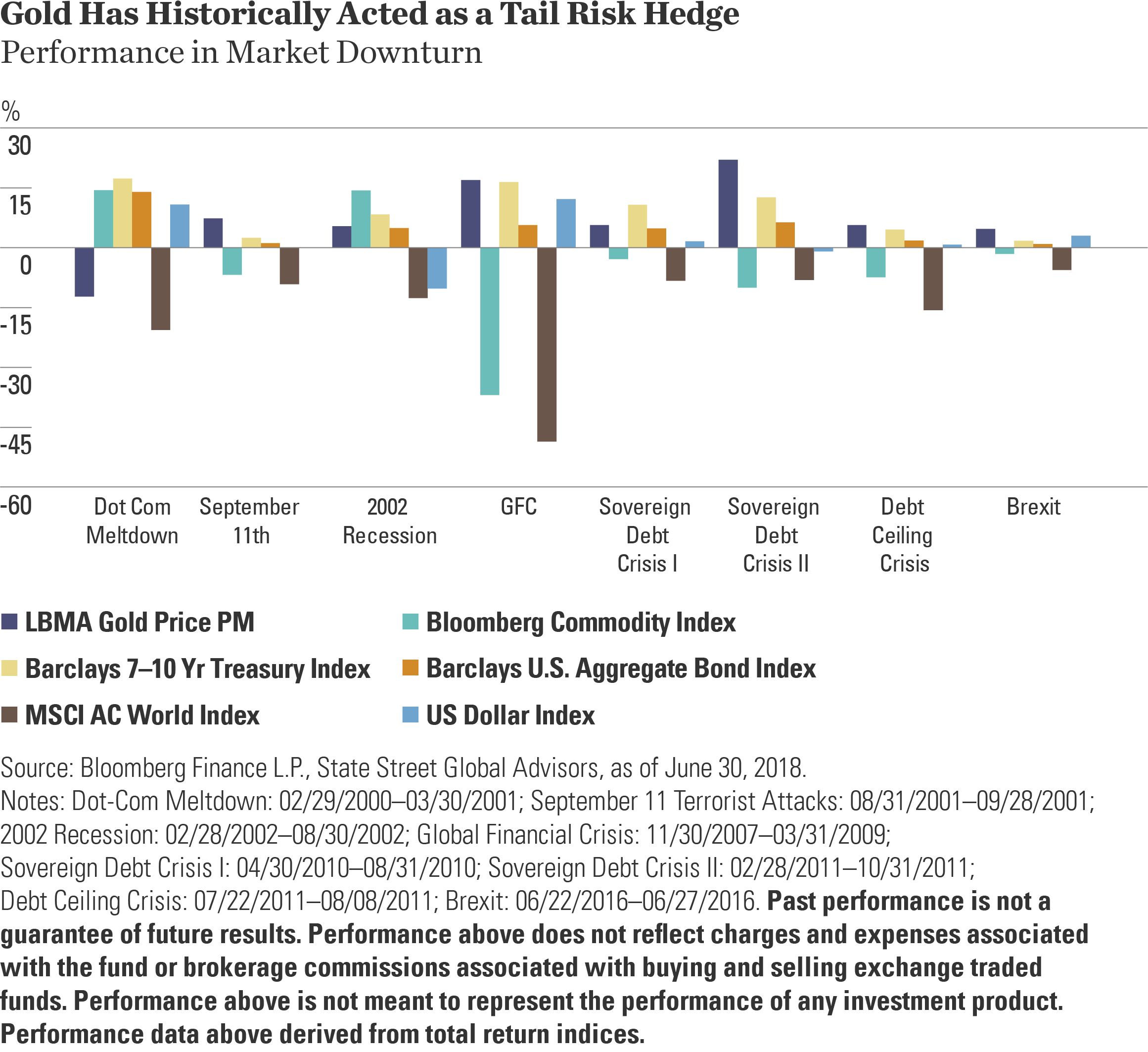
    But back to gold, if it is not an inflation-hedge, if it is not an investment, it must then be an ideal tail-risk hedge, right?

    A tail-risk hedge is relying on an asset of last resort. That is, when and if our financial system fails, the only thing that’ll be left standing is gold, so the theory goes.

    And the data above seems to imply that gold as a tail-risk hedge works. I don’t buy it because tail-risks literally mean an end of the world-type situation which none of the episodes described above were or came to be.

    And what are you going to do with that bar of gold when the world ends? Nothing. Nobody would care for it.

    And how much of your total money are you willing to stake in gold? Five percent? Ten percent? If the remaining 90 percent goes to zero, does it even matter?

    No amount of opining on gold would be complete without citing a few of the choicest quotes from the goat himself.

    I will say this about gold. If you took all the gold in the world, it would roughly make a cube 68 feet on a side. Now for that same cube of gold, it would be worth at today’s market prices about $9.6 trillion dollars – that’s probably about a third of the value of all the stocks in the United States. For $9.6 trillion dollars, you could have all the farmland in the United States with $200 billion output per year, have about 16 Exxon Mobils, each generating $40 billion of profit per year and still have a trillion dollars of walking-around money. And if you offered me the choice of looking at some 68 foot cube of gold and looking at it all day, and you know me touching it and fondling it occasionally…Call me crazy, but I’ll take the farmland and the Exxon Mobils any day.

    Warren Buffett in a 2011 letter to the shareholders of Berkshire Hathaway

    Gold gets dug out of the ground in Africa, or someplace. Then we melt it down, dig another hole, bury it again and pay people to stand around guarding it. It has no utility. Anyone watching from Mars would be scratching their head.

    Warren Buffett in a 1998 speech he gave at Harvard University

    Gold is not only a bad ‘investment’, but it acts as a terrible choke on an economy. Gold as an asset will never produce anything. Money, once converted into gold, gets locked up forever with very little of it recirculating back into the economy.

    Free flow of capital is vital for economic growth and prosperity. Access to capital helps entrepreneurs turn their ideas into products and services that benefit all of us. The businesses that are launched grow, create jobs and they generate the much-needed tax revenues for all stakeholders.

    Gold does none of those things but then it is not completely useless. It is a noble metal (resistant to corrosion) with wide-ranging applications in industry and medicine. It is unfortunate that the hoarders and the ‘investors’ have deemed it an asset class with the rest of us left scrambling to find alternatives to this very valuable commodity.

    The other utility that gold possesses is of course consumption in the form of jewelry. It is again unfortunate but then it looks so darn pretty.

    So, buy those gifts for the ladies in your lives but don’t think for a moment that you are investing.

    Thank you for your time.

    Cover image credit – Farddin Protik, Pexels

  • The Right Way To Insure Your Life

    The Right Way To Insure Your Life

    Life is fragile; we all know that. But we get so busy with our day-to-day living that we procrastinate and forget to do the most fundamental thing we should do to protect our families.

    And that is to insure our lives.

    It’ll cost some money, but it is the best money you’ll ever spend.

    And it is an expense. All insurance is an expense. Just like you don’t expect to make money insuring your car or your home or your health, you shouldn’t expect to make money insuring your life.

    Unfortunately though, the life insurance policies that are heavily marketed and sold always have an investment component mixed in.

    But unless you hate yourself and your money, run anytime anyone pitches you a product that combines life insurance with investment. Because you’ll be taken to the cleaners like you never showered all your life.

    Life insurance fundamentally is insuring your income against an income-stopping calamity. With that in mind, what kind of life insurance should you buy? But before that, who does not need life insurance because not everyone does. A few pointers…

    • A two-income family with no dependents likely does not need life insurance but I’d still buy one if the arrival of dependents is on the horizon.
    • Single people with no one depending on their income do not need life insurance. That includes kids. I mean people are insuring their kids’ lives? There is no Macaulay Culkin you got there yet who earns so much that his income matters. So don’t do that.

    Who needs life insurance?

    • A one-income family with or without dependents. If no dependents, insuring the life of the income-earner is of course super important. If with dependents, you would likely want to insure both parents’ lives. You’d need some support structure in place if your non-earning spouse unexpectedly dies.
    • A two-income family with dependents in almost all situations should insure both incomes.
    • A two-income family with no dependents but with large debt obligations. If both incomes are needed to support your cost structure, you’d naturally want to insure both lives.

    How much life insurance to buy?

    I would start with 10 times your annual income at the minimum and move up from there. Same amount for your spouse if applicable. At some point on that income scale, you’d want to switch from insuring against an income loss to insuring your current and future living expenses.

    What I mean to say is that if you make $100,000 a year, you should aim for a million dollars in life insurance as a baseline. But if you make say $500,000 a year and can sustain a decent life on $100,000 a year, then you’ll want to use $2 million in life insurance amount as a baseline. That should cover about 20 years of expenses in case something happens to you or your partner.

    So, if you make normal income, you’d want 10 times that as a baseline life insurance amount. But if you are making bank and can live on a fraction of that, you’d use 20 times your living expenses as a baseline life insurance amount.

    Just enough insurance and not a dollar more.

    What kind should you buy?

    A 20-year, level-term policy is an ideal kind. Twenty years is about the time it’ll take you to right your ship financially to get to a point where you won’t need to protect your income much. Twenty years is also about the time needed for your dependents to graduate college and be on their own.

    You can probably stretch that duration of income protection to 30 years but none beyond that.

    Insuring your whole life is never worth it because insurance companies are not in the business of losing money. They know death is certain. They’ll design their policies to recoup their cost plus a big slice of profits…from you.

    And insurance businesses are some of the most profitable businesses around. Don’t make them even more profitable on your dime.

    Level-term means that the premiums remain the same for the entire duration of the policy.

    How much should it roughly cost?

    A $1 million, 20-year level-term policy for someone in his 30’s with no pre-existing health conditions should cost around $50 each month. That is dirt cheap.

    Of course, the older you get, the more you will pay but it’ll still cost you a fraction of the other junky policies you are likely to get sold.

    How to buy?

    I’ve used SelectQuote, an insurance marketplace and there are others you can use but where you price shop is less important. What is more important is the insurance provider you pick.

    You’ll fill out a questionnaire at one of these marketplaces and they’ll send you a list of options to choose from. Pick the one that is rated A or better by A.M. Best, an insurance rating company. Just type the name of the insurance provider along with A.M. Best rating in the Google search bar and you’ll know their grade.

    And it is a grade. Your insurance contract is only worth the paper it is printed on if the business behind it will be around to honor that contract. Insurance businesses rarely fail so you shouldn’t worry too much but why take a chance.

    Every situation is different so talking to someone in the know might be warranted but if you are talking about investments and you’ve got a family to support and you don’t got life insurance, a big, big shame on you. Get on it today because your life can end but your family’s life will alter for far worse overnight.

    Thank you for your time.

    Cover image credit – Willsantt, Pexels

  • Currency Movements Don’t Matter

    Currency Movements Don’t Matter

    Stock market composition changes by the country. United States is tech heavy. Canada is banks heavy. Australia is commodities heavy. Emerging markets were commodities heavy a few years back. They turned tech heavy with the rise of the likes of Alibaba and Tencent.

    That can change and it will change. That is the nature of capitalism. You don’t know what can come out of where in this globally connected world.

    Which means we must participate, not just in our home country but in countries across the globe. We want to own the means of production wherever they exist. And we make that possible through ownership stakes in businesses.

    But when you own a piece of say a German business as an American investor, you not only have to deal with the ups and downs of the goings in that business but also how the dollar performs against the euro. Because all you care as an American investor is how much money you are making in dollars as most of your spending is in dollars.

    But currencies are always on the move with respect to each other. So, if that German business you own grows profits by 25 percent, the value of that business should also rise by 25 percent on the German stock exchange.

    But if the euro depreciates by 20 percent against the dollar for whatever reason, you are back to where you started in dollar terms, even though the business you own is flourishing.

    Too many numbers? Let me explain with more numbers 🙂 .

    Say one euro buys one dollar today. Now say that German business you own made 100 million euros in profits this year. And come next year, it grew profits by 25 percent, so it made 125 million euros.

    But then say the euro depreciated against the dollar by 20 percent. If you do the math, 125 million euro after 20 percent decline in the value of euro against the dollar means that business made 100 million in dollar terms.

    So even when that German business earned 25 percent more money, you in dollar terms are where you were last year because the currency moved against you.

    If the euro on the other hand were to rise by 20 percent, not only did that German business earn 125 million euros in profits but you also pocketed another 20 percent on top of that in dollar terms because of the euro appreciating against the dollar.

    Return on Foreign Assets ± Changes in Currency Exchange Rate = Total Return on Investment

    But people don’t like this added currency volatility on top of the volatility inherent with owning stocks. So, the ‘smart’ ones hedge their exposure to currencies when investing overseas.

    But you should not and here is why…

    • Currency hedgers care about short-term performance. They are tactical investors trying to anticipate currency movements while going in and out of investments. That works great if you can forecast the moves right every time but one bad forecast and there goes all your past gains and more.
    • Forecasting currency movements is a fool’s game. The smartest folks with the absolute best training in finance and international economics do not know which way the currencies will move. The value of a nation’s currency depends upon the prevailing interest rates in that nation relative to other nations, on trade surpluses and deficits of that nation, the economic health of that nation and on rumors and truths about natural resources in that nation. Then there are political and military causes that move currencies. There are health and education outcomes that move currencies. In short, a complex network of factors that interact with each other to make a country’s currency worth what it is today. And that changes every day. Forecasting these moves right every time is a near impossibility.
    • Currency hedging does not come for free. It costs real money, and that added cost will wipe away any benefits with hedging in the long run.
    • Speaking of the long run, it in fact hurts to hedge your currency exposure. You invest internationally not only to diversify your portfolio but also to diversify into other currencies and economies. Weaker currencies get stronger and stronger currencies get weaker. And then the weaker currencies get stronger again. That is the nature of how goods and services flow in our global economy and you want to participate and profit from that.

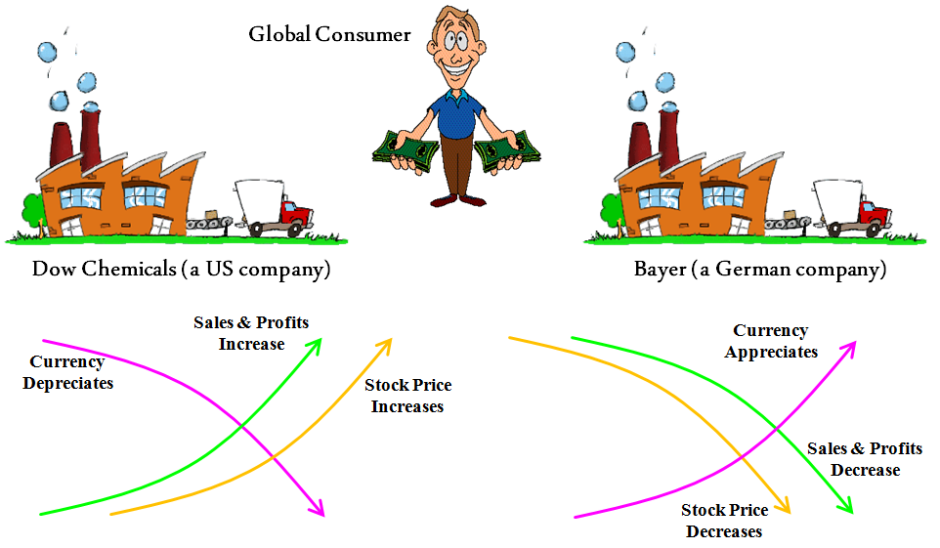
    Here is an example of why you shouldn’t care about currencies. Say this guy below owns a factory somewhere in India and he needs a certain chemical that is manufactured by both Bayer (a German company) and Dow Chemicals (an American company). As long as both companies make the exact same chemical, the only thing that decides who gets his business will be the relative exchange rate differences between the rupee, the dollar, and the euro. A company based in a country with a cheaper currency will almost always get that business, which then increases that company’s revenues and profits, and which then gets reflected in its stock price.

    So, a company with a cheaper currency wins and the one with a more expensive currency loses but if you own both in a globally diversified portfolio, that ebb and flow of currency moves washes itself out.

    It doesn’t happen overnight, but it does in the long run. All currencies eventually revert to their natural, long-term average. And you get to profit from that process of reversion to the average as you rebalance your portfolio into investments with temporarily weaker currencies.

    Owning investments across the globe is great but hedging the currency exposure is not.

    Thank you for your time.

    Cover image credit – Ibrahim Boran, Pexels

  • Don’t Fall For The Growth Trap

    Don’t Fall For The Growth Trap

    As the rest of the world lay in ruins, the United States was pretty much the only country left with production capacity intact post-World War 2. And with a lot of rebuilding that was to follow meant that the nation’s factories were running overtime to meet the inexhaustible demand.

    Plus, with exploding domestic consumption as the returning soldiers bought homes and filled those homes with wives and babies, appliances, gadgets, and automobiles, meant that it was nothing but boom times for businesses all over. New products were being created, technological breakthroughs were happening everywhere and a quintessential company at the forefront of all that boom was IBM. IBM was tech before tech became tech. It was the cutting edge.

    So, say in 1950, you were trying to decide between two investments, IBM and Standard Oil of New Jersey (ExxonMobil of today). Which one would you have picked?

    Standard Oil of New Jersey is what I’d define as an established business with a growing clientele, but at no point was the demand for their products expected to shoot the lights out. A steady-eddy business is what I mean.

    IBM, on the other hand, backed with plenty of capital, was literally there at the onset of the computing revolution, expecting to serve a rapidly growing market.

    With this added context, which one would you have invested in? Jeremy Siegel, in his book The Future for Investors, lays out this growth trap by providing data on key financial metrics that any ‘real’ investor would look at to evaluate a potential investment.

    IBM did better than Standard Oil on almost all metrics that matter. Plus, as information technology advanced and computing became an integral part of the global economy, the tech sector which IBM was a big part of, grew from a mere three percent of the stock market to 18 percent.

    The oil sector’s representation, on the other hand, which Standard Oil was again a big part of, shrunk from 20 percent of the stock market’s value to less than five percent.

    So, now with this data and with near perfect foresight, you would have picked IBM. And if you did, you did well.

    But the shocker is that had you picked Standard Oil, you would have done even better.

    How is this possible? How did Standard Oil outearn IBM even though IBM beat Standard Oil on every relevant growth metric?

    It is all about expectations that were built into the price of IBM versus that of Standard Oil. Investors were expecting nothing but glory from IBM and hence the shares were priced accordingly. And Standard Oil shares were priced according to its prospects that were meh as compared to that of IBM.

    That is typical of most growth businesses where when investors expect more growth, they pay for that growth through ever higher stock prices.

    But then the realized growth doesn’t match expectations and hence the performance gap.

    IBM was expected to grow faster than Standard Oil, so investors bid up its share price to a point that even though the projected growth materialized, it was not enough to outearn investors’ expectations.

    Standard Oil selling commodity products, on the other hand, was not expected to create magic and hence was priced accordingly. But investors’ expectations turned out to be lower than what Standard Oil came to deliver and hence the outperformance.

    Obvious prospects for physical growth in a business do not translate into obvious profits for investors.

    Benjamin Graham, The Intelligent Investor

    What applies to companies also applies to sectors.

    Compare for example the financial sector with the energy sector and their respective representation in the S&P 500 index at the start and at the end of the period. Even though the financial sector grew from being less than 1% of the index to about 20% and even when the energy sector shrunk from about 22% to 6%, the actual sector return differences were not that far apart.

    In fact, the energy sector out earned the financial sector on average (refer to the Actual Sector Return column).

    Part of the reason for the financial sector’s underperformance compared to that of the energy sector was due to the continuous addition of new businesses that diluted some of the growth.

    But a much bigger reason for the relative underperformance was the valuation investors were willing to pay for the expected future growth.

    Inquiring minds might want to know the difference between the last two columns in the table above so let me address that. We know how an index is created and how it evolves over time. Companies get added and deleted based on what the index creators think is a good representation of the sector and the economy at any given time. The composition of the index hence evolves as the economy evolves through replacing the old with the new.

    But had the index constituents remained unchanged, the return you would have earned is what the last column shows. The second to last column is the performance of the actual index that takes into account all the additions and deletions.

    So, if you bought once and held, you did better than all the changes you would have made over time. Now that again is a remarkable testament to the power of doing nothing and holding on for the long-term.

    Plus, what companies do you think get added to an index? The darlings of today.

    And what gets booted out? The also rans.

    But the darlings of today don’t come cheap. Expectations are high and you pay for them through a richer stock price. And hence the underperformance.

    What applies to sectors also applies to stock markets of entire countries. A faster growing country does not automatically translate into better stock market performance.

    History shows that many of the best-performing investments are instead found in shrinking industries and in slower-growing countries.

    Jeremy Siegel, The Future for Investors 

    That is also one of the reasons why investing in IPOs is usually a terrible deal. You pay through the nose for the anticipation of inflated future growth but when that growth does not materialize, you are left holding the bag.

    Yet the benefit of all this growth are funneled not to individual investors but instead to the innovators and founders, the venture capitalists who fund the projects, the investment bankers who sell the shares, and ultimately to the consumer, who buys better products at lower prices. The individual investor, seeking a share of the fabulous growth that powers the world economy, inevitably loses out.

    Jeremy Siegel, The Future for Investors 

    But then we want the innovators and the founders and the folks who risk their capital to be rewarded. And they do. But the rewards to the public market investors are few and far between.

    So, until incentives get better aligned, I’d stay away.

    In short, if you are looking to invest in something, anything that excites you based on how fast a company or a sector or a country is growing, you know how that’ll likely turn out.

    But if you decide to stick with the dull and the boring, you’ll likely outearn the hot and the sexy. Not because there is anything special about that strategy but because with the dull and the boring, the expectations better match reality.

    And that is everything.

    Thank you for your time.

    Cover image credit – Pixabay

  • Hardwired To Be Screwed

    Hardwired To Be Screwed

    Gary Smith in his book, Standard Deviations talks about the evolution of peppered moths, usually found in nature as light-colored creatures. But that was not always the case.

    A trickle of dark-colored moths started appearing in 1848 England but by 1895, ninety-eight percent of the peppered moths found there were dark-colored.

    But by the 1950s, the pendulum started to swing back towards light-colored moths, and it swung back to a point that dark colored moths today are so rare that they may in fact go extinct.

    So why this back and forth? The evolutionary explanation for that is that the rise of dark-colored moths coincided with the pollution spewing Industrial Revolution. The blackening of trees from soot and smog gave dark-colored moths an ability to camouflage themselves better and hence were less likely to be noticed by predators.

    And since they were more likely to survive long enough to reproduce, they came to dominate the gene pool. England’s clean air laws reversed that course as pollution-free trees allowed light-colored moths to blend in better with their environment. That is nature and evolution taking its course with a big help from humans, allowing the fittest and the most adaptive to flourish and thrive.

    We are here today because our ancestors, since the hunter-gatherer days, did all they could to fight and survive the many existential threats they faced. Life in those days was short and fragile. The availability of resources like food, clothing and shelter was unreliable. Life shortening hazards lurked everywhere. As a species, our strength lay in our minds. The instincts and the traits that helped our ancestors survive and thrive are still hardwired in us today.

    And one of those traits is the fear of an impending loss. We, evolutionarily, are designed to take flight even at the slightest inkling of a loss. That is because when you were living on the edge as what life was like in times past, to lose even a little meant your very existence was at stake.

    So quite naturally, the human beings that are with us today are here because their ancestors did everything they could to protect themselves from danger. The gene pool hence is designed with loss aversion as a primary mechanism for survival.

    Amos Tversky and Daniel Kahneman in their work on Prospect Theory demonstrated that people react differently to positive and negative changes to their status quo. The pain of losing is psychologically twice as powerful as the pleasure of gaining, so the theory goes.

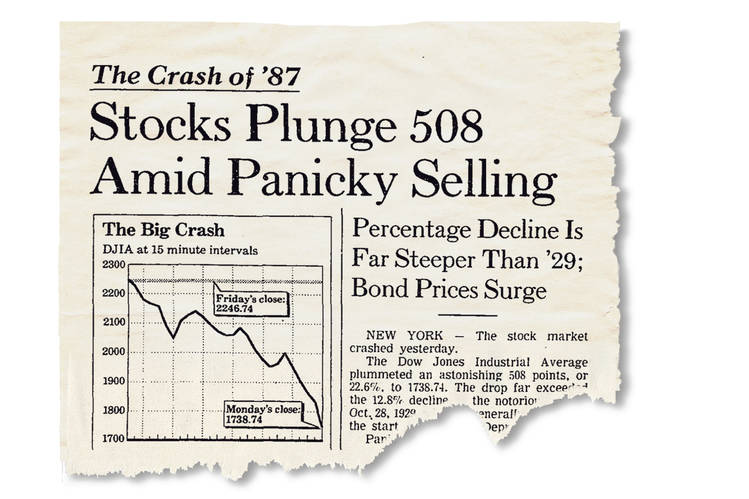
    And hence we quiver at the prospect of a headline like this…

    That 508-point drop might appear like a run of the mill drop these days until you realize that that is a 23 percent drop in a single day. But that was in 1987.

    The real shocker though is that had you Rip Van Winkled from the start to the end of that year and remained invested, you didn’t feel nothing. The stock market was in fact up for the year.

    So, you didn’t lose any money had you not sold. And that is the key thing to remember about stock market downturns. Once you’ve bought right, you don’t have less until you sell.

    And what worked for us evolutionarily to survive as a species turns out to be a disaster when applied to our modern-day world of money. It leads us to precisely do the thing we should not be doing and that is to panic sell out of fear of losing all our savings.

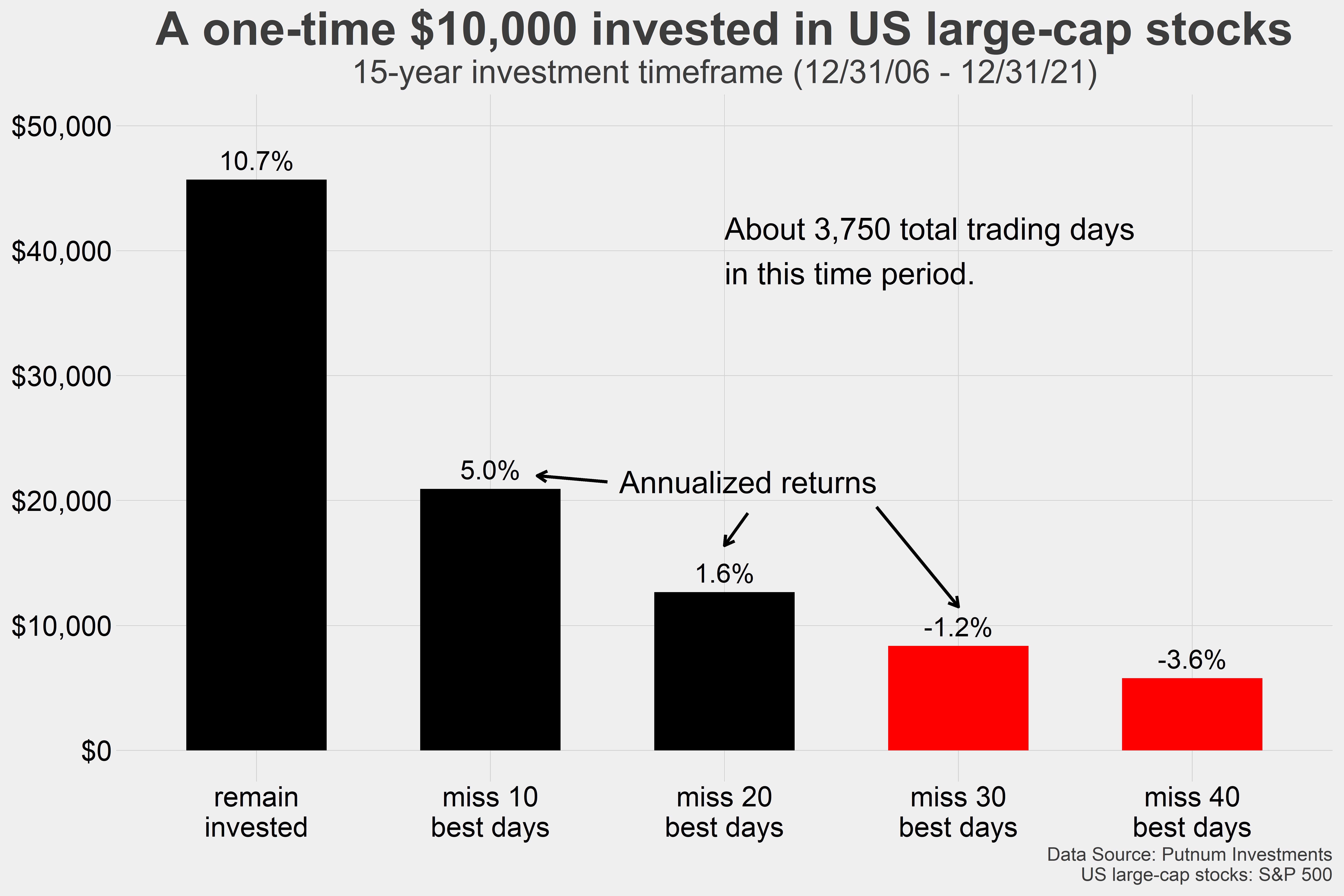
    But what if you could dance in and out of the markets to circumvent the pain of a loss? Glad you asked and it doesn’t work. Miss a few of the best days when the markets violently turn, and it is game over.

    But can you capitalize on this up and down and then up in the markets? Yes, you can, and you do that by being strategic about how you invest.

    Strategic investors are plan-focused on how they deploy their savings. Tactical investors on the other hand invest based on whims. They invest based on what they feel is going to happen next in the markets. Or some try a mix of both as I ultra-sparingly do with my own money just to see what an occasional self-flagellation feels like.

    Tactical investors are constantly changing their portfolios. There is no process. They watch every move the markets make. They are always on the hunt for something ‘better’ than what they already own.

    Tactical investors feel like they are ‘in the game’. They are making decisions all the time which they think will get them closer to their goals. And it is supposedly fun. It is fun to be ‘in the game’. It is fun to make things happen than it is to let things happen.

    And it gives them something to brag about to whoever cares to be bragged about on. They of course only brag about their winners.

    Strategic investors do not play any of those games. They set out with a plan designed around their goals and populate their plans with investments that are statistically likely to get them to meet those goals. They invest like how pension funds invest – matching assets (the investments they own) with liabilities (expenses they’ll incur) to make sure they won’t run out of money before they run out of time.

    Strategic investors take a long-term, process-oriented approach to investing, centered around prudent asset allocation, opportunistic re-balancing, and tax efficiency.

    And most importantly, strategic investors act based on what has already happened whereas tactical investors act in anticipation of what is going to happen. Think about it for a moment. By being strategic, you act based on facts and data. By investing tactically, you act based on hunches. Do you really want to manage your life savings based on hunches?

    If you believe in astrology or tarot card reading, you might be more of a tactical investor. For all others, take a strategic approach to managing your savings and sleep easy. Market declines will come and go but you will still have to send your kids to college and plan to retire someday. A solid plan with the right mix of investments with lots of tuning along the way is how you get there.

    Thank you for your time.

    Cover image credit – Cottonbro, Pexels

  • Capital Preservation And Growth Doesn’t Exist

    Capital Preservation And Growth Doesn’t Exist

    Stocks are volatile. And a big reason they’ll remain volatile is because of where a stock’s value comes from.

    The value of a stock today is the sum of all the cash flows (dividends) a business (stock) will deliver to its shareholders in perpetuity, discounted to the present at the appropriate discount rate.

    Not to get fooled by this apparently trivial setup, small changes in i and r can have profound implications on the value of a business.

    Every business returns profits to its shareholders in the form of dividends, D.

    Not all businesses will. Some won’t be able to get to profitability but hold a decent number of them spread across industries and the dividend stream continuing in perpetuity is a given.

    r defines the growth rate of those dividends. That is tied to business profits and profits tend to grow long-term. They don’t grow in a straight line and hence the implied volatility.

    The discount rate, i quantifies risk. The greater the risk to profits, the higher the rate of return you’ll require. You expect to get paid for the extra risk you are taking with a riskier investment. Your expected rate of return hence rises for that investment.

    Expected rate of return is the discount rate. So, when the discount rate rises, the value of a stock falls because the discount rate is in the denominator. And when the discount rate falls, the value of a stock rises.

    That is why small changes in interest rates cause stock prices to change. Because discount rates are not derived in a vacuum. They rely on prevailing interest rates and if they rise, discount rates rise as well. If you can safely earn eight percent on a Treasury bond, why would you buy stocks? Stocks, hence, have to offer better than eight percent.

    So, when interest rates are higher, discount rates are higher, and stock prices are lower. That is how you get the higher rate of return when you buy stocks because you get to buy them at the cheap.

    So, with r and i constantly changing, the intrinsic value of a stock changes too. And hence the inherent volatility with stocks. There is no way to avoid it.

    That makes up the growth side of your portfolio.

    With bonds and using the same equation above, cash flows from bonds are the interest payments you receive. We’ll continue calling them D.

    But D for bonds is fixed. They don’t grow once a bond is purchased (r = 0).

    The discount rate i for a bond is the interest rate set when you purchased that bond. Unless you decide to sell that bond before it matures, the discount rate doesn’t change and so doesn’t the bond’s value.

    Bonds preserve capital. They hence make the capital preservation part of your portfolio.

    If you want complete preservation of capital, growth cannot come. If you want growth, you must accept volatility. You must accept it because that is the only way to outrun inflation in the long run.

    So why do we see investments that claim to preserve capital but also provide growth? LJM Preservation and Growth Fund was supposed to do that. Then it went belly-up overnight. Jeff Malec in a piece at Seeking Alpha, LJM – The Autopsy does a great job describing what happened and leaves us with this excerpt.

    In the span of 48 hours in and around that spike, LJMIX had lost 82% of its more than $700 million in investor assets, failing to strike an NAV for several days as the manager, clearing firms, the exchange, and regulators tried to sift through the trades. It was the investment manager equivalent of a suicide, overdosing on the tempting drug of an investing free lunch.

    Free lunch? Capital preservation and growth doesn’t exist. It is an oxymoron. Capital preservation means eliminating downside. Eliminating the downside means eliminating volatility but then you don’t get the upside. We just did the math.

    Risk and return are inextricably intertwined. In almost every country where economists have studied securities returns, stocks have had higher returns than bonds. Further, if you want those high stock returns, you are going to have to pay for them by bearing risk; this is a polite way of saying that in the course of earning those higher returns, your portfolio is going to lose a truckload of money from time to time. Conversely, if you desire perfect safety, then resign yourself to low returns. It really cannot be any other way.

    William Bernstein, The Investor’s Manifesto

    One way I don’t see volatility with my own money is that I don’t peek at my accounts as often. It is not easy these days. That stock market app on your phone is the worst thing that will happen to your money.

    Yet not everyone can take the stock market heat. So, we bring some bonds into the mix to turn down that heat. The right ones in the right proportion act as ideal ballasts against stock market volatility. They won’t make you the same money, but they’ll help you remain at peace.

    Because what you don’t want to have happen is that you abandon your plan at the worst possible times. And worst possible times will come.

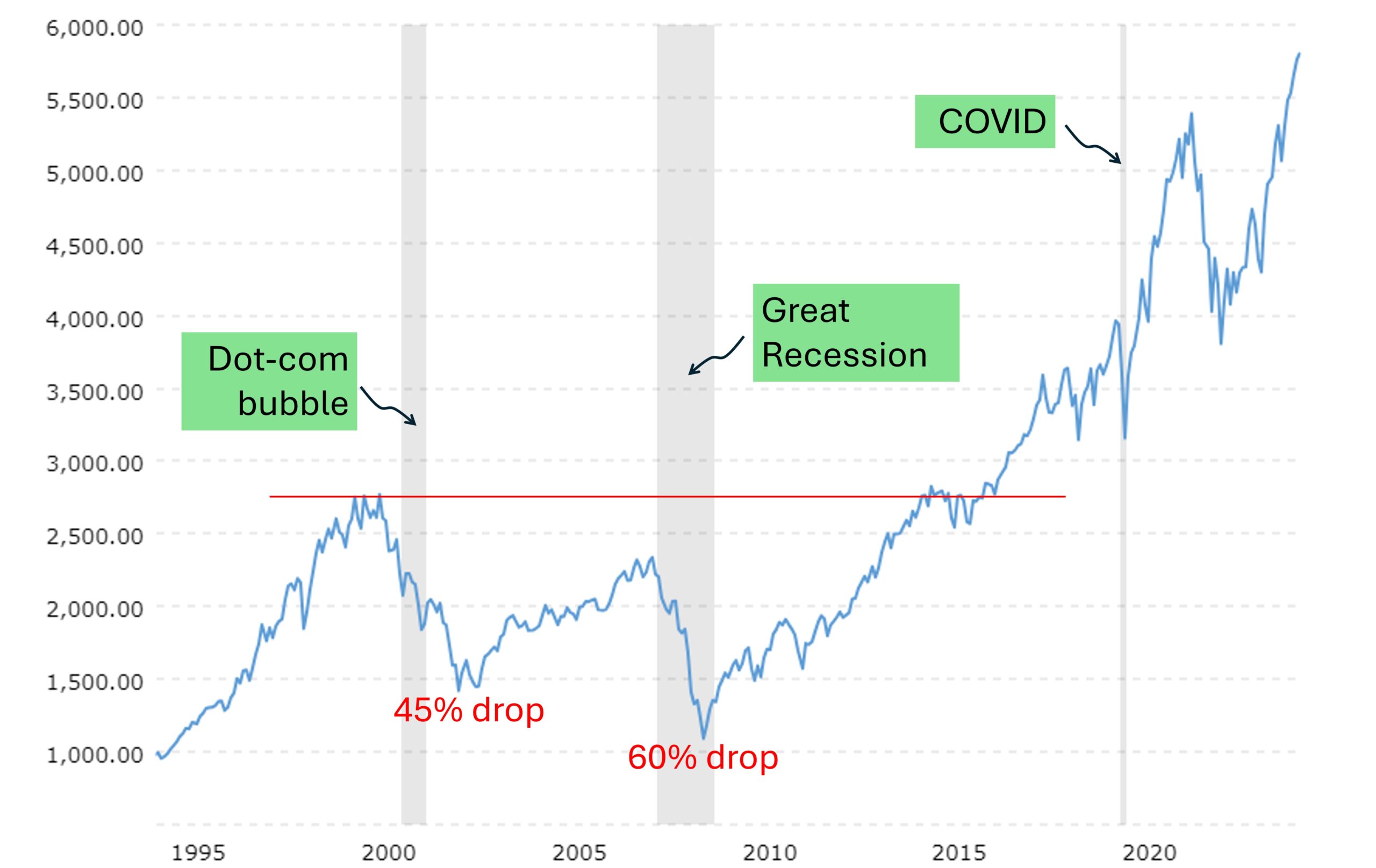
    Real (inflation-adjusted) S&P 500 price data
    Source: Macrotrends

    The stock market people haven’t seen them lately, but times were rough after the Dot-com crash. It took 15 years to get back to breakeven and let me tell you, it was not an easy ride.

    So, you don’t need the craziness if you don’t need it. Because the goal in the end is not to die rich but to have lived a great life. And if stock market volatility interferes with that, that is no good.

    Thank you for your time.

    Cover image credit – Mike, Pexels